










Lesson Five Reading II

Site: TeacherFutures
Course: Teaching in a Digital Age (Discussion Board)
Book: Lesson Five Reading II
Printed by: Guest user
Date: Saturday, 4 July 2026, 11:25 AM

Table of contents

1. Methods of Teaching: Campus-Focused

Five perspectives on teaching are examined and related to epistemologies and theories of learning, with a particular emphasis on their relevance to a digital age. In particular, this lesson covers the following topics:

2. Scenario: A Stats Lecturer Fights the System


Clive (looking carefully at his partner, Jean): So, what went wrong at work today?

Jean: So, you noticed – nice.

Clive: Now don’t take it out on me. How could I have avoided the slamming of the door, the shouting at the cat, and the almost instant demand for a large glass of wine – which incidentally is sitting on your desk?

Jean (grabbing the wine): Well, today was the last straw. I got the results of the student end-of-term evaluation of my new class I’ve been teaching.

Clive: Bad, eh?

Jean: Well, first, the rankings are odd: about 30 percentage As, about 5 percentage Bs, 15 percentage Cs, 15 percentage D’s and 35 percentage E’s – NOT a normal curve of distribution! They either loved me or hated me, but the average – which is all Harvey, the stupid head of department, looks at – came out as a D, which means any chance of promotion next year just went straight out the window. I’m now going to have to explain myself to that old buffoon who last taught a class when slate tablets were the latest technology.

Clive: I’m not going to say I told you so, but…..

Jean: DON’T go there. I know I’m bloody mad to have stopped lecturing and tried to engage the students more.  I could kill that faculty development guy who persuaded me to change how I teach. I didn’t mind all the extra work, not even the continual fighting with the guy from Facilities who kept telling me to put all the tables and chairs back properly – he was just a jerk – and I loved the actual teaching, which was stimulating and deeply satisfying, but what really finished me was when the department wouldn’t change the exam. I’ve been trying to get the kids to question what is meant by a sample, discuss alternative ways of looking at significance, solve problems, and then they go and give the poor kids multiple-choice questions that just assessed their memory of statistical techniques and formulae. No wonder most of the students were mad at me.

Clive: But you’ve always claimed that the students enjoyed your new way of teaching.

Jean: Well, I was fooled by them. From the student comments on the evaluation, it seemed that about a third of them really did like the lessons and some even said it opened up their eyes to what statistics is all about, but apparently what the rest wanted was just a crib sheet they could use to answer the exam questions.

Clive: So, what are you going to do now?

Jean: I honestly don’t know. I know what I’m doing is right, now I’ve been through all the changes. Those kids won’t have crib sheets when they start work, they will have to interpret data, and when they get into advanced-level science and engineering courses they won’t be able to use statistics properly if I just teach to the exam. They will know a bit about statistics but not how to do it properly.

Clive: So, you’ll have to get the department to agree to change the exam.

Jean: Yeah, good luck with that, because everyone else will have to change how they teach if we do that.

Clive: But I thought the whole reason for you changing your teaching was that the university was worried it wasn’t producing graduates with the right kind of skills and knowledge needed today.

Jean: You’re right, but the problem is Harvey won’t support me – he’s an old school down to his socks and underpants and thinks that what I am doing is just trendy – and without his support, there’s no way the rest of the department is going to change.

Clive: OK, so just relax for now and have a glass of wine and we’ll go out somewhere nice for dinner. That will help clear my mind of the thought of Harvey in his socks and underpants. Then you can hear about my day.


3. Five Perspectives on Teaching

The first thing to be said about teaching methods is that there is no law or rule that says teaching methods are driven by theories of learning. Especially in post-secondary education, most instructors would be surprised if their teaching was labeled as behaviourist or constructivist. On the other hand, it would be less than accurate to call such teaching ‘theory-free’. We have seen how views about the nature of knowledge are likely to impact on preferred teaching methods. But it would be unwise to press this too hard. A great deal of teaching, at least at a post-secondary level, is based on an apprenticeship model of copying the same methods used by one’s own teachers, then gradually refining them from experience, without a great deal of attention being paid to theories of how students actually learn.

Dan Pratt (1998) studied 253 teachers of adults, across five different countries, and identified ‘five qualitatively different perspectives on teaching,… presenting each perspective as a legitimate view of teaching‘:

  • Transmission: Effective delivery of content (an objectivist approach)
  • Apprenticeship: Modelling ways of being (learning by doing under supervision)
  • Developmental: Cultivating ways of thinking (constructivist/cognitivist)
  • Nurturing: Facilitating self-efficacy (a fundamental tenet of connectivist MOOCs)
  • Social reform: Seeking a better society.

It can be seen that each of these perspectives relate to theories of learning to some extent, and they help to drive methods of teaching. So in practical terms, I will start by looking at some common methods of teaching, and assessing their appropriateness for developing the knowledge and skills.

I will organize these various methods of teaching into two lessons. The first lesson will discuss design models that derive from a more traditional school or campus-based teaching, and the second lesson will be focused on design models that make more use of Internet technologies.


4. The Origins of the Classroom Design Model


Our institutions are a reflection of the times in which they were created. Francis Fukuyama, in his monumental writing on political development and political decay (20112014), points out that institutions that provide essential functions within a state often become so fixed over time in the original structures that they fail to adapt and adjust to changes in the external environment. We need therefore to examine in particular the roots of our modern educational systems, because teaching and learning in the present day is still strongly influenced by institutional structures developed many years ago. Thus, we need to examine the extent to which our traditional campus-based models of teaching remain fit for a digital age.

The large urban school, college, or university, organized by age stratification, learners meeting in groups, and regulated units of time, was an excellent fit for an industrial society. In many ways, it matched the way work was organized in factories. In effect, we still have a predominantly industrial model of educational design, which in large part remains our default design model even today.

Some design models are so embedded in tradition and convention that we are often like fish in water – we just accept that this is the environment in which we have to live and breath. The classroom model is a very good example of this. In a classroom-based model, learners are organized in classes that meet on a regular basis at the same place at certain times of the day for a given length of time over a given period (a term or semester).

This is a design decision that was taken more than 150 years ago. It was embedded in the social, economic, and political context of the 19th century. This context included:

  • The industrialization of society which provided ‘models’ for organizing both work and labor, such as factories and mass production.
  • The movement of people from rural to urban occupations and communities, with increased density resulting in larger institutions.
  • The move to mass, education to meet the needs of industrial employers and an increasingly large and complex range of state-managed activities, such as government, health, and education.
  • Voter enfranchisement and hence the need for a better-educated voting public.
  • Over time, demand for more equality, resulting in universal access to education.

However, over the span of 150 years, our society has slowly changed. Many of these factors or conditions no longer exist, while others persist, but often in a less dominant way than in the past. Thus we still have factories and large industries, but we also have many more small companies, greater social and geographical mobility, and above all a massive development of new technologies that allow both work and education to be organized in different ways.

This is not to say that the classroom design model is inflexible. Teachers for many years have used a wide variety of teaching approaches within this overall institutional framework. But in particular, the way in which our institutions are structured strongly affects the way we teach. We need to examine which of the methods built around a classroom model are still appropriate in today’s society, and, more of a challenge, whether we could build new or modified institutional structures that would better meet the needs of today.


5. Transmissive Lectures: Learning by Listening


6. Definition

‘[Lectures] are more or less continuous expositions by a speaker who wants the audience to learn something.’

Bligh, 2000


This specific definition is important as it excludes contexts where a lecture is deliberately designed to be interrupted by questions or discussion between instructors and students. 


7. The Origins of the Lecture

Transmissive lectures can be traced back as far as ancient Greek and Roman times, and certainly from at least the start of the European university, in the 13th century. The term ‘lecture’ comes from Latin, meaning a reading. In the 13th century, most books were extremely rare. They were painstakingly handcrafted and illustrated by monks, often from fragments or collections of earlier and exceedingly rare and valuable scrolls from ancient Greek or Roman times, or were translated from Arabic sources, since much documentation was destroyed in Europe during the Dark Ages following the fall of the Roman empire. As a result, a university would often have only one copy of a book, and it may have been the only copy available in the world. The library and its collection, therefore, became critical to the reputation of a university, and professors had to borrow the only text from the library and literally read from it to the students, who dutifully wrote down their own version of the lecture.

Lectures themselves belong to an even longer oral tradition of learning, where knowledge is passed on by word of mouth from one generation to the next. In such contexts, accuracy and authority (or power in controlling access to knowledge) are critical for ‘accepted’ knowledge to be successfully transmitted. Thus, accurate memory, repetition, and a reference to authoritative sources become exceedingly important in terms of validating the information transmitted. The great sagas of the ancient Greeks and, much later, of the Vikings, are examples of the power of oral transmission of knowledge, continued even today through the myths and legends of many indigenous communities.


This illustration from a thirteenth-century the manuscript shows Henry of Germany delivering a lecture to university students in Bologna, Italy, in 1233. What is striking is how similar the whole context is to lectures today, with students taking notes, some talking at the back, and one clearly asleep. Certainly, if Rip Van Winkle awoke in a modern lecture theatre after 800 years of sleeping, he would know exactly where he was and what was happening.

Nevertheless, the lecture format has been questioned for many years. Samuel Johnson (1709-1784) over 200 years ago said of lectures:

‘People have nowadays…got a strange opinion that everything should be taught by lectures. Now, I cannot see that lectures can do as much good as reading the books from which the lectures are taken…Lectures were once useful, but now, when all can read, and books are so numerous, lectures are unnecessary.’

Boswell, 1791


What is remarkable is that even after the invention of the printing press, the radio, television, and the Internet, the transmissive lecture, characterized by the authoritative instructor talking to a group of students still remains the dominant methodology for teaching in many institutions, even in a digital age, where information is available at a click of a mouse. It could be argued that anything that has lasted this long must have something going for it. On the other hand, we need to question whether the transmissive lecture is still the most appropriate means of teaching, given all the changes that have taken place in recent years, and in particular given the kinds of knowledge and skills needed in a digital age.


8. What Does Research Tell Us About the Effectiveness of Lectures?

Whatever you may think of Samuel Johnson’s opinion, there has indeed been a great deal of research into the effectiveness of lectures, going back to the 1960s, and continued through until today. The most authoritative analysis of the research on the effectiveness of lectures remains Bligh’s (2000). He summarized a wide range of meta-analyses and studies of the effectiveness of lectures compared with other teaching methods and found consistent results:

  • The lecture is as effective as other methods for transmitting information (the corollary of the course is that other methods – such as video, reading, independent study, or Wikipedia – are just as effective as lecturing for transmitting information).
  • Most lectures are not as effective as a discussion for promoting thought.
  • Lectures are generally ineffective for changing attitudes or values or for inspiring interest in a subject.
  • Lectures are relatively ineffective for teaching behavioural skills.

Bligh also examined research on student attention, on memorizing, and on motivation, and concluded (p.56):

‘We see evidence… once again to suppose that lectures should not be longer than twenty to thirty minutes – at least without techniques to vary stimulation.‘

These research studies have shown that in order to understand, analyze, apply, and commit information to long-term memory, the learner must actively engage with the material. In order for a lecture to be effective, it must include activities that compel the student to mentally manipulate the information. Many lecturers, of course, do this, by stopping and asking for comments or questions throughout the lecture – but many do not.

Again, although these findings have been available for a long time, and YouTube videos now last approximately eight minutes and TED talk 20 minutes at a maximum, teaching in many educational institutions is still organized around a standard 50-minute lecture session or longer, with, if students are lucky, a few minutes in the end for questions or discussion. There are two important conclusions from the research:

  • Even for the sole purpose for which lectures may be effective – the transmission of information – the 50-minute lecture needs to be well organized, with frequent opportunities for student questions and discussion (Bligh provides excellent suggestions on how to do this in his book);
  • For all other important learning activities, such as developing critical thinking, deep understanding, and application of knowledge – the kind of skills needed in a digital age – lectures are ineffective. Other forms of teaching and learning – such as opportunities for discussion and student activities – are necessary.

9. Does New Technology Make Lectures More Relevant?

Over the years, institutions have made massive investments in adding technologies to support lecturing. Powerpoint presentations, multiple projectors and screens, clickers for recording student responses, even ‘back-chat’ channels on Twitter, enabling students to comment on a lecture – or more often, the lecturer – in real-time (surely the worst form of torture for a speaker), have all been tried. Students have been asked to bring tablets or laptops to class, and universities, in particular, have invested millions of dollars in the state of the art lecture theatres. Nevertheless, all this is just lipstick on a pig. The essence of a lecture remains the transmission of information, all of which is now ready and, in most cases, freely available in other media and in more learner-friendly formats.

I worked in a college wherein one program all students had to bring laptops to class. At least in these classes, there were some activities to do related to the lecture that required the students to use the laptops during class time. However, in most classes, this took less than 25 percentage of the lesson time. Most of the other time, students were talked at, and as a result used their laptops for other, mainly non-academic activities, especially playing online poker.

Faculty often complain about students use of technology such as mobile phones or tablets, for ‘non-relevant’ multitasking in class, but this misses the point. If most students have mobile phones or laptops, why are they still having to come to a lecture hall in person? Why can’t they get a podcast or a video of the lecture? Second, if they are coming, why are the lecturers not requiring them to use their mobile phones, tablets, or laptops for study purposes, such as finding sources? Why not break the students into small groups and get them to do some online research then come back with group answers to share with the rest of the class? If lectures are to be offered, the aim should be to make the lecture engaging in its own right, so the students are not distracted by their non-academic online activity.


10. Is There Then No Role for Lectures in a Digital Age?

Lectures though still have their uses. One example is an inaugural lecture I attended for a newly appointed research professor. In this lecture, the professor summarised all the research he and his team had done, resulting in treatments for several cancers and other diseases. This was a public lecture, so he had to satisfy not only other leading researchers in the area but also a lay public with often no science background. He did this by using excellent visuals and analogies. The lecture was followed by a small wine and cheese reception for the audience. The lecture worked for several reasons:

  • First of all, it was a celebratory occasion to bring together family, colleagues, and friends.
  • Second, it was an opportunity to pull together nearly 20 years of research into a single, coherent narrative or story.
  • Third, the lecture was well supported by the appropriate use of graphics and video.
  • Lastly, he put a great deal of work into preparing this lecture and thinking about who would be in the audience – much more preparation than would have been the case if this was just one of many lectures in a course.

McKeachie and Svinicki (2006, p. 58) believe that lecturing is best used for:

  • Providing up-to-date material that can’t be found in one source
  • Summarizing the material found in a variety of sources
  • Adapting material to the interests of a particular group
  • Initially helping students discover key concepts, principles or ideas
  • Modeling expert thinking

The last point is important. Faculty often argue that the real value of a lecture is to provide a model for students of how the faculty member, as an expert, approaches a topic or problem. Thus, the important point of the lecture is not the transmission of content (facts, principles, ideas), which the students could get from just reading, but an expert way of thinking about the topic. The trouble with this argument for lectures is three-fold:

  • Students are rarely aware that this is the purpose of the lecture, and therefore focus on memorizing the content, rather than the ‘modeling’ of expert thinking.
  • Faculty themselves are not explicit about how they are doing the modeling (or fail to offer other ways in which modeling could be used, so students can compare and contrast).
  • Students get no practice themselves in modeling this skill, even if they are aware of the modeling.

Perhaps more importantly, looking at McKeachie and Svinicki’s suggestions, would it not be better for the students, rather than the lecturer, to be doing these activities in a digital age?

So, yes, there are a few occasions when lectures work very well. But in a digital age, they should not be the default model for regular teaching. There are much better ways to teach that will result in better learning over the length of a course or program.


11. Why are Lectures Still the Main Form of Educational Delivery?

Given all of the above, some explanation needs to be offered for the persistence of the lecture into the 21st century. Here are some suggestions:

  • In fact, in many areas of education, the lecture has been replaced, particularly in many elementary or primary schools.
  • Architectural inertia: a huge investment has been made by institutions in facilities that support the lecture model. What is to happen to all that real estate if it is not used? (As Winston Churchill said, ‘We shape our buildings and our buildings shape us‘).
  • In North America, the Carnegie unit of teaching, which is based on a notion of one hour per week of classroom time per credit over a 13 week period. It is easy then to divide a three-credit course into 39 one hour lectures over which the curriculum for the course must be covered. It is on this basis that teaching load and resources are decided.
  • Faculty in post-secondary education has no other model for teaching. This is the model they are used to, and because the appointment is based on training in research or work experience, and not on qualifications in teaching, they have no knowledge of how students learn or confidence or experience in other methods of teaching.
  • Many experts prefer the oral tradition of teaching and learning, because it enhances their status as an expert and source of knowledge; being allowed an hour of other people’s time to hear your ideas without major interruption is very satisfying on a personal level (at least for me when I’m lecturing).
  • See Scenario C at the start of this lesson.


12. Is There a Future for Lectures in a Digital Age?

That depends on how far into the future one wants to look. Given the inertia in the system, lectures are likely still to predominate for another ten years, but after that, in most institutions, courses based on three lectures a week over 13 weeks will have disappeared. There are several reasons for this:

  • All content can be easily digitalized and made available on-demand at a very low cost.
  • Institutions will be making greater use of dynamic video (not talking heads) for demonstration, simulations, animations, etc. Thus most content modules will be multi-media.
  • Third, open textbooks incorporating multi-media components and student activities will provide the content, organization, and interpretation that are the rationale for most lectures.
  • Lastly, and most significantly, the priority for teaching will have changed from information transmission and organization to knowledge management, where students have the responsibility for finding, analyzing, evaluating, sharing and applying knowledge, under the direction of a skilled subject expert. Project-based learning, collaborative learning, and situated or experiential learning will become much more widely prevalent. Also, many instructors will prefer to use the time they would have spent on a series of lectures in providing more direct, individual and group learner support, thus bringing them into closer contact with learners.

This does not mean that lectures will disappear altogether, but they will be special events, and probably multi-media, synchronously, and asynchronously delivered. Special events might include:

  • A professor’s summary of her latest research
  • The introduction to a course
  • A point mid-way through a course for taking stock and dealing with common difficulties, or
  • The wrap-up to a course

Lectures will provide a chance for instructors to make themselves known, to impart their interests and enthusiasm, and to motivate learners, but this will be just one, relatively a small, but important component of a much broader learning experience for students.

For a different and informed perspective on the role and future of lectures, see Christine Gross-Loh, 2016.


13. Interactive Lectures, Seminars, and Tutorials: Learning by Talking


14. The Theoretical and Research Basis for Dialogue and Discussion

Researchers have identified a distinction, often intuitively recognized by instructors, between meaningful and rote learning (Asubel et al., 1978). Meaningful learning involves the learner going beyond memorization and surface comprehension of facts, ideas, or principles, to a deeper understanding of what those facts, ideas or principles mean to them. Marton and Saljö, who have conducted a number of studies that examined how university students actually go about their learning, make the distinction between deep and surface approaches to learning (see, for instance, Marton and Saljö, 1997). Students who adopt a deep approach to learning tend to have a prior intrinsic interest in the subject. Their motivation is to learn because they want to know more about a topic. Students with a surface approach to learning are more instrumental. Their interest is primarily driven by the need to get a pass grade or qualification.

Subsequent research (e.g. Entwistle and Peterson, 2004) showed that as well as students’ initial motivation for study, a variety of other factors also influence students’ approaches to learning. In particular, surface approaches to learning are more commonly found when there is a focus on:

  • Information transmission
  • Tests that rely mainly on memory
  • A lack of interaction and discussion

On the other hand, deeper approaches to learning are found when there is a focus on:

  • Analytical or critical thinking or problem-solving
  • In-class discussion
  • Assessment based on analysis, synthesis, comparison, and evaluation

Constructivists believe that knowledge is mainly acquired through social processes which are necessary to move students beyond surface learning to deeper levels of understanding. Connectivist approaches to learning also place heavy emphasis on networking learners, with all participants learning through interaction and discussion between each other, driven both by their individual interests and the extent to which these interests connect to the interests of other participants. The very large numbers participating in connectivist MOOCs means that there is a high probability of converging interests for all participants, although those interests may vary considerably over the whole group.

Laurillard (2001), and Harasim (2017), have emphasized that academic knowledge requires students to move constantly from the concrete to the abstract and back again, and to build or construct knowledge based on academic criteria such as logic, evidence and argument. This, in turn, requires a strong teacher presence within a dialectical environment, in which argument and discussion within the rules and criteria of the subject discipline are encouraged and developed by the instructor or teacher. Laurillard calls this a rhetorical exercise, an attempt to get learners to think about the world differently. Conversation and discussion is critical if this is to be achieved.

The combination of theory and research here suggests the need for frequent interaction between students, and between teacher and students, for the kinds of learning needed in a digital age. This interaction usually takes the form of semi-structured discussion. I will now examine how this kind of learning has traditionally been facilitated by educators.


15. Seminars and Tutorials

Definitions

seminar is a group meeting (either face-to-face or online) where a number of students participate at least as actively as the teacher, although the teacher maybe responsible for the design of the group experience, such as choosing topics and assigning tasks to individual students.

tutorial is either a one-on-one session between a teacher and a student, or a very small group (three or four) of students and an instructor, where the learners are at least as active in discussion and presentation of ideas as the teacher.

seminars


Seminars and tutorials again have a very long history, going back at least to the time of Socrates and Aristotle. Both were tutors to the aristocracy of ancient Athens. Aristotle was the private tutor to Alexander the Great when Alexander was young.  Socrates was the tutor of Plato, the philosopher, although Socrates denied he was a teacher, rebelling against the idea common at that time in ancient Greece that ‘a teacher was a vessel that poured its contents into the cup of the student’. Instead, according to Plato, Socrates used dialogue and questioning ‘to help others recognize on their own what is real, true, and good.’ (Stanford Encyclopedia of Philosophy.) Thus it can be seen that seminars and tutorials reflect a strongly constructivist approach to learning and teaching.

The format can vary a great deal. One common format, especially at the graduate level, although similar practices can be found at the school/k-12 level, is for the teacher to set advance work for a selected number of students, and then have the selected students present their work to the whole group, for discussion, criticism, and suggestions for improvement. Although there may be time for only two or three student presentations in each seminar, over a whole semester every student gets their turn. Another format is to ask all the students in a group to do some specified advanced reading or study, then for the teacher to introduce questions for general discussion within the seminar that requires students to draw on their earlier work.

Tutorials

Tutorials are a particular kind of the seminar that is identified with Ivy League universities, and in particular Oxford or Cambridge. There may be as few as two students and a professor in a tutorial and the meeting often follows closely the Socratic method of the student presenting his or her findings and the professor rigorously questioning every assumption made by the student – and also drawing in the other student to the discussion.

Both these forms of dialogical learning can be found not only in classroom contexts but also online. However, in general, the pedagogical similarities between online and face-to-face discussions are much greater than the differences.


16. Are Seminars a Practical Method in a Massive Education System?

For many faculty, the ideal teaching environment is Socrates sitting under the linden tree, with three or four dedicated and interested students. Unfortunately, the reality of mass higher education makes this impossible for all but the most elite and expensive institutions.

However, seminars for 25-30 students are not unrealistic, even in public undergraduate education. More importantly, they enable the kind of teaching and learning that are most likely to facilitate the types of skills needed from our students in a digital age. Seminars are flexible enough to be offered in class or online, depending on the needs of the students. They are probably best used when students have done individual work before the seminar. Of upmost importance, though, is the ability of teachers to teach successfully in this manner, which requires different skills from transmissive lecturing.

Although expansion of student numbers in higher education is part of the problem, it’s not the whole problem. Other factors, such as senior professors teaching less, and focusing mainly on graduate students, lead to larger classes at undergraduate level that use transmissive lecturing. And if more senior or experienced instructors switched from transmissive lectures, and instead required students to find and analyse content for themselves, this would free up more time for them to spend on seminar-type teaching.

So, it as much an organizational issue, a matter of choice and priorities, as an economic issue. The more we can move towards a seminar approach to teaching and learning and away from large, transmissive lectures, the better, if we are to develop students with the skills needed in a digital age.


17. Learning by Doing: Experiential Learning

Ryerson University’s Law Practice program is a good example of a blended learning approach to experiential learning. For more details

Learning by doing is one of Pratt’s five teaching approaches. There are a number of different approaches or terms within the broad heading of experiential learning, such as cooperative learningadventure learning, and apprenticeship.  I will use the term ‘experiential learning‘ as a broad umbrella term to cover this wide variety of approaches to learning by doing. I will deal with an apprenticeship as a separate section because of its traditional (if tacit) role in preparing university and college instructors, although it can be seen as just one of several methods of experiential learning.


18. What is Experiential Learning?

Simon Fraser University (2010) has defined experiential learning as:

The strategic, active engagement of students in opportunities to learn through doing, and reflection on those activities, which empowers them to apply their theoretical knowledge to practical endeavors in a multitude of settings inside and outside of the classroom.

There are many different theorists in this area, such as John Dewey (1938) and more recently David Kolb (1984). There is a wide range of design models that aim to embed learning within the real world contexts, including:

  • Laboratory, workshop or studio work
  • Apprenticeship
  • Problem-based learning
  • Case-based learning
  • Project-based learning
  • Inquiry-based learning
  • Cooperative (work- or community-based) learning

The focus here is on some of the main ways in which experiential learning can be designed and delivered, with particular respect to the use of technology, and in ways that help develop the knowledge and skills needed in a digital age. (For a more detailed analysis of experiential learning, see Moon, 2004).


19. Core Design Principles

Experiential learning focuses on learners reflecting on their experience of doing something, so as to gain conceptual insight as well as practical expertise. Kolb’s experiential learning model suggests four stages in this process:

  • Active experimentation
  • Concrete experience
  • Reflective observation
  • Abstract conceptualization

Experiential learning is a major form of teaching at several universities, including the University of Waterloo in Canada and Aalborg University in Denmark. The conditions needed to ensure that experiential learning is effective can be found from the Association for Experiential Education.

The next section examines different ways in which these principles have been applied.


20. Experiential Design Models

There are many different design models for experiential learning, but they also have many features in common.

Laboratory, Workshop, or Studio Work

Concordia University wood shop

Today, we take almost for granted that laboratory classes are an essential part of teaching science and engineering. Workshops and studios are considered critical for many forms of trades training or the development of creative arts. Labs, workshops, and studios serve a number of important functions or goals, which include:

  • To give students hands-on experience in choosing and using common scientific, engineering or trades equipment appropriately.
  • To develop motor skills in using scientific, engineering or industrial tools or creative media.
  • To give students an understanding of the advantages and limitations of laboratory experiments.
  • To enable students to see science, engineering or trade work ‘in action’.
  • To enable students to test hypotheses or to see how well concepts, theories, procedures actually work when tested under laboratory conditions.
  • To teach students how to design and/or conduct experiments.
  • To enable students to design and create objects or equipment in different physical media.

An important pedagogical value of laboratory classes is that they enable students to move from the concrete (observing phenomena) to the abstract (understanding the principles or theories that are derived from the observation of phenomena). Another is that the laboratory introduces students to a critical cultural aspect of science and engineering, that all ideas need to be tested in a rigorous and particular manner for them to be considered ‘true’.

One major criticism of traditional educational labs or workshops is that they are limited in the kinds of equipment and experiences that scientists, engineers, and trades people need today. As scientific, engineering and trades equipment becomes more sophisticated and expensive, it becomes increasingly difficult to provide students in schools especially but increasingly now in colleges and universities direct access to such equipment. Furthermore traditional teaching labs or workshops are capital and labour intensive and hence do not scale easily, a critical disadvantage in rapidly expanding educational opportunities.

Because laboratory work is such an accepted part of science teaching, it is worth remembering that teaching science through laboratory work is in historical terms a fairly recent development. In the 1860s neither Oxford nor Cambridge University was willing to teach empirical science. Thomas Huxley, therefore, developed a program at the Royal School of Mines (a constituent college of what is now Imperial College, of the University of London) to teach school-teachers how to teach science, including how to design laboratories for teaching experimental science to school children, a method that is still the most commonly used today, both in schools and universities.

At the same time, scientific and engineering progress since the nineteenth century has resulted in other forms of scientific testing and validation that take place outside at least the kind of ‘wet labs’ so common in schools and universities. Examples are nuclear accelerators, nanotechnology, quantum mechanics, and space exploration. Often the only way to observe or record phenomena in such contexts is remotely or digitally. It is also important to be clear about the objectives of the lab, workshop, and studio work. There may now be other, more practical, more economic, or more powerful ways of achieving these objectives through the use of new technology, such as remote labs, simulations, and experiential learning. These will be examined in more detail later in this book.

Problem - Based Learning

The earliest form of systematized problem-based learning (PBL) was developed in 1969 by Howard Barrows and colleagues in the School of Medicine at McMaster University in Canada, from where it has spread to many other universities, colleges, and schools. This approach is increasingly used in subject domains where the knowledge base is rapidly expanding and where it is impossible for students to master all the knowledge in the domain within a limited period of study. Working in groups, students identify what they already know, what they need to know, and how and where to access new information that may lead to resolution of the problem. The role of the instructor (usually called a tutor in classic PBL) is critical in facilitating and guiding the learning process.

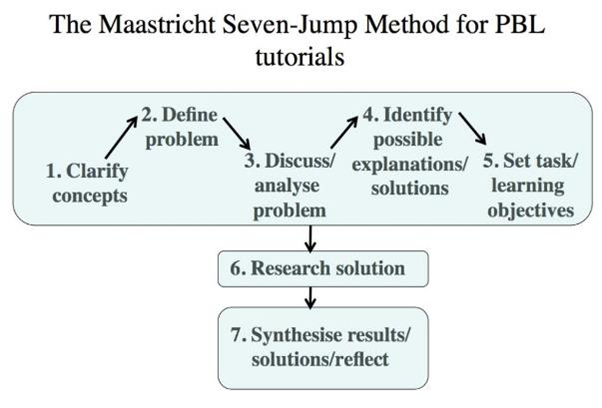
Usually, PBL follows a strongly systematized approach to solving problems, although the detailed steps and sequence tend to vary to some extent, depending on the subject domain. The following is a typical example:

(derived from Gijeselaers, 1995)

Traditionally, the first five steps would be done in a small face-to-face class tutorial of 20-25 students, with the sixth step requiring either individual or small group (four or five students) private study, with a seventh step being accomplished in a full group meeting with the tutor. However, this approach also lends itself to blended learning in particular, where the research solution (step 6) is done mainly online, although some instructors have managed the whole process online, using a combination of synchronous web conferencing and asynchronous online discussion.

Developing a complete the problem-based learning curriculum is challenging, as problems must be carefully chosen, increasing in complexity and difficulty over the course of study, and problems must be chosen so as to cover all the required components of the curriculum. Students often find the problem-based learning approach challenging, particularly in the early stages, where their foundational knowledge base may not be sufficient to solve some of the problems. (The term ‘cognitive overload’ has been used to describe this situation.) Others argue that lectures provide a quicker and more condensed way to cover the same topics. The assessment also has to be carefully designed, especially if a final exam carries heavyweight in grading, to ensure that problem-solving skills as well as content coverage are measured.

However, research (see, for instance, Strobel and van Barneveld, 2009) has found that problem-based learning is better for long-term retention of material and developing ‘replicable’ skills, as well as for improving students’ attitudes towards learning. There are now many variations on the ‘pure’ PBL approach, with problems being set after initial content has been covered in more traditional ways, such as lectures or prior reading, for instance.

The methodology of problem-based learning however is one essential tool for developing the knowledge and skills needed in a digital society.

Case-Based Learning

With case-based teaching, students develop skills in analytical thinking and reflective judgment by reading and discussing complex, real-life scenarios.

University of Michigan Centre for Research on Teaching and Learning


Case-based learning is sometimes considered a variation of PBL, while others see it as a design model in its own right. As with PBL, case-based learning uses a guided inquiry method but usually requires the students to have a degree of prior knowledge that can assist in analyzing the case. There is usually more flexibility in the approach to case-based learning compared to PBL. Case-based learning is particularly popular in business education, law schools, and clinical practice in medicine, but can be used in many other subject domains.

Herreid (2004) provides eleven basic rules for case-based learning.

  1. Tells a story

  2. Focuses on an interest-arousing issue

  3. Set in the past five years

  4. Creates empathy with the central characters

  5. Includes direct quotations from the characters

  6. Relevant to the reader

  7. Must have pedagogic utility

  8. Conflict provoking

  9. Decision forcing

  10. Has generality

  11. Is short

Using examples from clinical practice in medicine, Irby (1994) recommends five steps in case-based learning:

  • Anchor teaching in a (carefully chosen) case
  • Actively involve learners in discussing, analyzing and making recommendations regarding the case
  • Model professional thinking and action as an instructor when discussing the case with learners
  • Provide direction and feedback to learners in their discussions
  • Create a collaborative learning environment where all views are respected

Case-based learning can be particularly valuable for dealing with complex, interdisciplinary topics or issues which have no obvious ‘right or wrong’ solutions, or where learners need to evaluate and decide on competing, alternative explanations. Case-based learning can also work well in both blended and fully online environments. Marcus, Taylor, and Ellis (2004) used the following design model for a case-based blended learning project in veterinary science:

Blended learning sequence involving online learning resources, Marcus, Taylor and Ellis, 2004

Other configurations are of the course also possible, depending on the requirements of the subject.

Project-Based Learning

Project-based learning is similar to case-based learning but tends to be longer and broader in scope, and with even more student autonomy/responsibility in the sense of choosing sub-topics, organizing their work, and deciding on what methods to use to conduct the project. Projects are usually based around real-world problems, which give students a sense of responsibility and ownership in their learning activities.

Once again, there are several best practices or guidelines for successful project work. For instance, Larmer and Mergendoller (2010) argue that every good project should meet two criteria:

  • Students must perceive the work as personally meaningful, as a task that matters and that they want to do well.
  • A meaningful project fulfills an educational purpose.

The main danger with project-based learning is that the project can take on a life of its own, with not only students but the instructor losing focus on the key, essential learning objectives, or important content areas that may not get covered. Thus project-based learning needs careful design and monitoring by the instructor.

Inquiry-Based Learning

Inquiry-based learning (IBL) is similar to project-based learning, but the role of the teacher/instructor is somewhat different. In project-based learning, the instructor decides the ‘driving question’ and plays a more active role in guiding the students through the process. In inquiry-based learning, the learner explores a theme and chooses a topic for research, develops a plan of research, and comes to conclusions, although an instructor is usually available to provide help and guidance when needed.

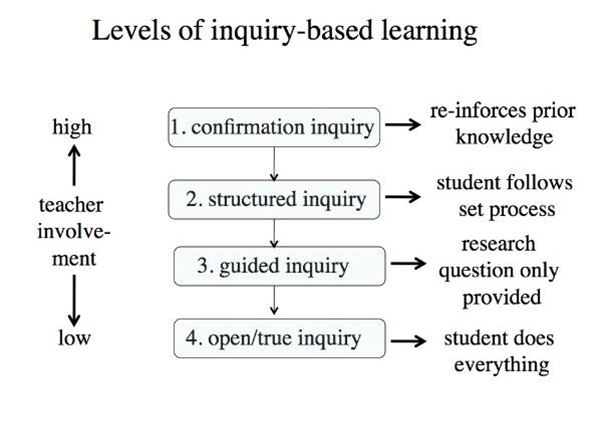
Banchi and Bell (2008) suggest that there are different levels of inquiry and students need to begin at the first level and work through the other levels to get to ‘true’ or ‘open’ inquiry as follows:

 Levels of inquiry-based learning, from Banchi and Bell (2008)

It can be seen that the fourth level of inquiry describes the graduate thesis process, although proponents of inquiry-based learning has advocated its value at all levels of education.


21. Experiential Learning in Online Learning Environments

Some advocates of experiential learning is highly critical of online learning, because, they argue, it is impossible to embed learning in real-world examples. However, this is an oversimplification, and there are contexts in which online learning can be used very effectively to support or develop experiential learning, in all its variations:

  • Blended or Flipped Learning: Although group sessions often start off the process, and/or bring a problem or project to conclusion, they are usually done in a classroom or lab setting. However students can increasingly conduct the research and information gathering by accessing resources online, by using online multimedia resources to create reports or presentations, and by collaborating online through group project work or through critique and evaluation of each other’s work;
  • Fully online: Increasingly, instructors are finding that experiential learning can be applied fully online, through a combination of synchronous tools such as web conferencing, asynchronous tools such as discussion forums and/or social media for group work, e-portfolios, and multimedia for reporting, and remote labs for experimental work.

Indeed, there are circumstances where it is impractical, too dangerous, or too expensive to use real-world experiential learning. Online learning can be used to simulate real conditions and to reduce the time to master a skill. Flight simulators have long been used to train commercial pilots, enabling trainee pilots to spend less time mastering fundamentals on real aircraft. Commercial flight simulators are still extremely expensive to build and operate, but in recent years the costs of creating realistic simulations have dropped dramatically.

Virtual world border crossing, Loyalist College, Ontario

Instructors at Loyalist College have created a ‘virtual’ fully functioning border crossing and a virtual car in Second Life to train Canadian Border Services Agents. Each student takes on the role of an agent, with his/her avatar interviewing the avatars of the travelers wishing to enter Canada. Other students play the travelers. All communication is done by voice communications in Second Life, with the people playing the travelers in a separate room from the students. Each student interviews three or four travelers and the entire class observes the interactions and discusses the situations and the responses. A secondary site for auto searches features a virtual car that can be completely dismantled so students learn all possible places where contraband may be concealed. This learning is then reinforced with a visit to the auto shop at Loyalist College and the search for an actual car. The students in the customs and immigration track are assessed on their interviewing techniques as part of their final grades. Students participating in the first year of the Second Life border simulation achieved a grade standing that was 28 percentage higher than the previous class who did not utilize a virtual world. The next class, using Second Life, scored a further 9 percentage higher. More details can be found here.

Staff in the Emergency Management Division at the Justice Institute of British Columbia have developed a simulation tool called Praxis that helps to bring critically incidents to life by introducing real-world simulations into training and exercise programs. Because participants can access Praxis via the web, it provides the flexibility to deliver immersive, interactive and scenario-based training exercises anytime, anywhere. A typical emergency might be a major fire in a warehouse containing dangerous chemicals. ‘Trainee’ first responders, who will include fire, police and paramedical personnel, as well as city engineers and local government officials are ‘alerted’ on their mobile phones or tablets, and have to respond in real-time to a fast-developing scenario, ‘managed’ by a skilled facilitator, following procedures previously taught and also available on their mobile equipment. The whole process is recorded and followed later by a face-to-face debriefing session.

Once again, design models are not in most cases dependent on any particular medium. The pedagogy transfers easily across different delivery methods. Learning by doing is an important method for developing many of the skills needed in a digital age.


22. Strengths and Weaknesses of Experiential Learning Models

How one evaluates experiential learning designs depends partly on one’s epistemological position. Constructivists strongly support experiential learning models, whereas those with a strong objectivist position are usually highly skeptical of the effectiveness of this approach. Nevertheless, problem-based learning in particular has proved to be very popular in many institutions teaching science or medicine, and project-based learning is used across many subject domains and levels of education. There is evidence that experiential learning, when properly designed, is highly engaging for students and leads to better long-term memory. Proponents also claim that it leads to deeper understanding, and develops skills for a digital age such as problem-solving, critical thinking, improved communication skills, and knowledge management. In particular, it enables learners to manage better highly complex situations that cross-disciplinary boundaries, and subject domains where the boundaries of knowledge are difficult to manage.

Critics though such as Kirschner, Sweller and Clark (2006) argue that instruction in experiential learning is often ‘unguided’, and pointed to several ‘meta-analyses’ of the effectiveness of problem-based learning that indicated no difference in problem-solving abilities, lower basic science exam scores, longer study hours for PBL students, and that PBL is more costly. They conclude:

In so far as there is any evidence from controlled studies, it almost uniformly supports direct, strong instructional guidance rather than constructivist-based minimal guidance during the instruction of novice to intermediate learners. Even with students with considerable prior knowledge, strong guidance when learning is most often found to be equally effective as unguided approaches.

Certainly, experiential learning approaches require a considerable restructuring of teaching and a great deal of detailed planning if the curriculum is to be fully covered. It usually means extensive re-training of faculty and careful orientation and preparation of students. I would also agree with Kirschner et al. that just giving students tasks to do in real-world situations without guidance and support is likely to be ineffective.

However, many forms of experiential learning can and do have strong guidance from instructors, and one has to be very careful when comparing matched groups that the tests of knowledge includes measurement of the skills that are claimed to be developed by experiential learning, and are not just based on the same assessments as for traditional methods, which often have a heavy bias towards memorization and comprehension.

On balance then, I would support the use of experiential learning for developing the knowledge and skills needed in a digital age, but as always, it needs to be done well, following best practices associated with the different design models.


23. Learning by Doing: Apprenticeship


24. The Importance of Apprenticeship as a Teaching Method

Apprenticeship is one of the most common and well-established forms of experiential learning. Bloom and his colleagues designated psycho-motor skills as the third domain of learning back in 1956. Learning by doing is particularly common in teaching motor skills, such as learning to ride a bicycle or play a sport, but examples can also be found in higher education, such as teaching practice, medical internships, and laboratory studies.

Apprenticeship is a particular way of enabling students to learn by doing. It is often associated with vocational training where a more experienced tradesman or journeyman models behaviour, the apprentice attempts to follow the model, and the journeyman provides feedback. However, apprenticeship is the most common method used to train post-secondary education instructors in teaching (at least implicitly), so there is a wide range of applications for an apprenticeship approach to teaching.

Because a form of apprenticeship is the often implicit, default model also for university teaching, and in particular for pre-service training of university instructors, apprenticeship will be discussed separately from other forms of experiential learning, although it is really just one, very commonly used, version.


25. Key Features of Apprenticeship

An apprentice being supervised Image: © BBC, 2014


‘It is useful to remember that apprenticeship is not an invisible phenomenon. It has key elements: a particular way of viewing learning, specific roles and strategies for teachers and learners, and clear stages of development, whether for a traditional or cognitive apprenticeship. But mostly it’s important to remember that in this perspective, one cannot learn from afar. Instead, one learns amid the engagement of participating in the authentic, dynamic, and unique swirl of genuine practice.‘

Pratt and Johnson, 1998


Schön (1983) argues that apprenticeship operates in ‘situations of practice that are frequently ill-defined and problematic, and characterized by vagueness, uncertainty, and disorder‘. Learning in apprenticeship is not just about learning to do (active learning), but also requires an understanding of the contexts in which the learning will be applied. In addition, there is a social and cultural element to the learning, understanding, and embedding the accepted practices, customs, and values of experts in the field. Pratt and Johnson (1998) identify the characteristics of a master practitioner, whom they define as:

A person who has acquired a thorough knowledge of and/or is especially skilled in a particular area of practice. Master practitioners:

  1. Possess great amounts of knowledge in their area of expertise, and are able to apply that knowledge in the difficult practice settings.
  2. Have well-organized, readily accessible schemas (cognitive maps) which facilitate the acquisition of new information.
  3. Have well-developed repertoires of strategies for acquiring new knowledge, integrating and organizing their schemas, and applying their knowledge and skills in a variety of contexts.
  4. …Are motivated to learn as part of the process of developing their identities in their communities of practice. They are not motivated to learn simply to reach some external performance goal or reward.
  5. Frequently display tacit knowledge in the form of:

    • Spontaneous action and judgments.
    • Being unaware of having learned to do these things.
    • Being unable or having difficulty in describing the knowing which their actions reveal.

Pratt and Johnson further distinguish two different but related forms of apprenticeship: traditional and cognitive. A traditional apprenticeship experience, based on developing a motor or manual skill involves learning a procedure and gradually developing mastery, during which the master and learner go through several stages.


26. University Apprenticeship

An intellectual or the cognitive apprenticeship model is somewhat different because this form of learning is less easily observable than learning motor or manual skills. Pratt and Johnson argue that in this context, master and learner must say what they are thinking during applications of knowledge and skills and must make explicit the context in which the knowledge is being developed, because the context is so critical to the way knowledge is developed and applied. Pratt and Johnson suggest five stages for cognitive and intellectual modeling (p. 99):

  • Modeling by the master and development of a mental model/schema by the learner.
  • Learner approximates replication of the model with master providing support and feedback (scaffolding/coaching).
  • Learner widens the range of application of the model, with less support from the master.
  • Self-directed learning within the specified limits acceptable to the profession.
  • Generalizing: learner and master discuss how well the model might work or would have to be adapted in a range of other possible contexts.

Pratt and Johnson provide a concrete example of how this apprenticeship model might work for a novice university professor (pp. 100-101). They argue that for cognitive apprenticeship it is important to create a forum or set of opportunities for:

Articulate discussion and authentic participation in the realities of practice from within the practice, not from just one single point of view. Only from such active involvement, and layered and cumulative experience does the novice move towards mastery.

The main challenge of the apprenticeship model in a university setting is that it is not usually applied in a systematic matter. The hope that young or new university teachers will have automatically learned how to teach just by observing their own professors teach leaves far too much to chance.

[Removed from Version 1: 3.5.4 Apprenticeship in online environments]


27. Strengths and Weaknesses

The main advantages of an apprenticeship model of teaching can be summarised as follows:

  • Teaching and learning is deeply embedded within complex and highly variable contexts, allowing rapid adaptation to real-world conditions.
  • It makes efficient use of the time of experts, who can integrate teaching within their regular work routine.
  • It provides learners with clear models or goals to aspire to.
  • It acculturates learners to the values and norms of the trade or profession.

On the other hand, there are some serious limitations with an apprenticeship approach, particularly in preparing for university teaching:

  • Much of a master’s knowledge is tacit, partly because their expertise is built slowly through a very wide range of activities.
  • Experts often have difficulty in expressing consciously or verbally the schema and ‘deep’ the knowledge that they have built up and taken almost for granted, leaving the learner often to have to guess or approximate what is required of them to become experts themselves.
  • Experts often rely solely on modeling with the hope that learners will pick up the knowledge and skills from just watching the expert in action, and don’t follow through on the other stages that make an apprenticeship model more likely to succeed.
  • There is clearly a limited number of learners that one expert can manage, given that the experts themselves are fully engaged in applying their expertise in often demanding work conditions which may leave little time for paying attention to the needs of novice learners in the trade or profession.
  • Traditional vocational apprenticeship programs have a very high attrition rate: for instance, in British Columbia, more than 60 percentage of those that enter a formal campus-based vocational apprenticeship program withdraw before successful completion of the program. As a result, there are large numbers of experienced tradespeople in the workforce without full accreditation, limiting their career development and slowing down economic development where there are shortages of fully qualified skilled workers.
  • In trades or occupations undergoing rapid change in the workplace, the apprenticeship model can slow adaptation or change in working methods, because of the prevalence of traditional values and norms being passed down by the ‘master’ that may no longer be as relevant in the new conditions facing workers. This limitation of the apprenticeship model can be clearly seen in the post-secondary education sector, where traditional values and norms around teaching are increasingly in conflict with external forces such as new technology and the massification of higher education.

Nevertheless, the apprenticeship model, when applied thoroughly and systematically, is a very useful model for teaching in highly complex, real-world contexts.


28. Learning by Being: The Nurturing and Social Reform Models of Teaching:

Image: Michigan State University, 2019

In this section, I will briefly discuss the last two of Pratt’s five teaching perspectives, nurturing and social reform.


29. The Nurturing Perspective

A nurturing perspective on teaching can best be understood in terms of the role of a parent. Pratt (1998) states:

We expect ‘successful’ parents to understand and empathize with their child; and that they will provide kind, compassionate, and loving guidance through content areas of utmost difficulty….The nurturing educator works with other issues…in different contexts and different age groups, but the underlying attributes and concerns remain the same. Learners’ efficacy and self-esteem issues become the ultimate criteria against which learning success is measured, rather than performance-related mastery of a content body.

There is a strong emphasis on the teacher focusing on the interests of the learner, on empathizing with how the learner approaches learning, of listening carefully to what the learner is saying and thinking when learning, and providing appropriate, supportive responses in the form of ‘consensual validation of experience‘. This perspective is driven partly by the observation that people learn autonomously from a very early age, so the trick is to create an environment for the learner that encourages rather than inhibits their ‘natural’ tendency to learn, and directs it into appropriate learning tasks, decided by an analysis of the learner’s needs.


30. The Social Reform Perspective

 Pratt (1998, p. 173) states:

Teachers holding a social reform perspective are most interested in creating a better society and view their teaching as contributing to that end. Their perspective is unique in that it is based upon an explicitly stated ideal or set of principles linked to a vision of a better social order. Social reformers do not teach in one single way, nor do they hold distinctive views about knowledge in general…these factors all depend on the particular ideal that inspires their actions.

This then in some ways is less a theory of teaching as an epistemological position, that society needs change, and the social reformer knows how to bring about this change through teaching and education. Indeed, as Figure 29 below illustrates, the social reform model of learning can be driven as much by the passions and concerns of learners as by those of their instructors.

Social reform model of learning

31. Past and Future: The Relevance of the Nurturing and Social Reform Methods for Connectivism

These two perspectives on teaching again have a long history, with echoes of:

Jean-Jacques Rousseau (1762): ‘Education should be carried out, so far as possible, in harmony with the development of the child’s natural capacities by a process of apparently autonomous discovery‘ (Stanford Encyclopedia of Philosophy).

Malcolm Knowles (1984): ‘As a person matures his self concept moves from one of being a dependent personality toward one of being a self-directed human being.’

Paulo Freire (2004): ‘Education makes sense because women and men learn that through learning they can make and remake themselves, because women and men are able to take responsibility for themselves as beings capable of knowing—of knowing that they know and knowing that they don’t.’

Ivan Illich (1971) (in his criticism of the institutionalization of education): ‘The current search for new educational funnels must be reversed into the search for their institutional inverse: educational webs which heighten the opportunity for each one to transform each moment of his living into one of learning, sharing, and caring.’

The reason why the nurturing and social reform perspectives on teaching are important is that they reflect many of the assumptions or beliefs around connectivism. Indeed, as early as 1971, Illich made this remarkable statement for the use of advanced technology to support “learning webs”:

The operation of a peer-matching network would be simple. The user would identify himself by name and address and describe the activity for which he sought a peer. A computer would send him back the names and addresses of all those who had inserted the same description. It is amazing that such a simple utility has never been used on a broad scale for publicly valued activity.

Well, those conditions certainly exist today. Learners do not necessarily need to go through institutional gateways to access information or knowledge, which is increasingly available and accessible through the Internet. MOOCs help to identify those common interests and connectivist MOOCs in particular aim to provide the networks of common interests and the environment for self-directed learning. The digital age provides the technology infrastructure and support needed for this kind of learning.


32. The Roles of Learners and Teachers

Of all the perspectives on teaching these two are the most learner-centered. They are based on a profoundly optimistic view of human nature, that people will seek out and learn what they need and will find the necessary support from caring, dedicated educators and/or from others with similar interests and concerns, and that individuals have the capacity and ability to identify and follow through with their own educational needs. It is also a more a radical view of education because it seeks to escape the political and controlling aspects of state or private institutions.

Within each of these two perspectives, there are differences of view about the centrality of teachers for successful learning. For Pratt, the teacher plays a central role in nurturing learning; for others such as Illich or Freire, professionally trained teachers are more likely to be the servant of the state than of the individual learner. For those supporting these perspectives on teaching, volunteer mentors or social groups organized around certain ideals or social goals provide the necessary support for learners.


33. Strengths and Weaknesses of These Two Approaches

There are, as always, a number of drawbacks to these two perspectives on teaching:

  • The teacher in a nurturing approach needs to adopt a highly dedicated and unselfish approach, putting the demands and needs of the learner first. This often means for teachers who are experts in their subject holding back the transmission and sharing of their knowledge until the learner is ‘ready’, thus denying to many subject experts their own identity and needs to a large extent.
  • Pratt argues that ‘although the content is apparently neglected, children taught by nurturing educators do continue to master it at much the same rate as children taught by curriculum-driven teaching methodologies‘, but no empirical evidence is offered to support this statement, although it does derive in Pratt’s case from strong personal experience of teaching in this way.
  • like all the other teaching approaches the nurturing perspective is driven by a very strong belief system, which will not necessarily be shared by other educators (or parents – or even learners, for that matter).
  • a nurturing perspective necessitates probably the most labor-intensive of all the teaching models other than apprenticeship, requiring a deep understanding on the part of the teacher of each learner and that learner’s needs; every individual learner is different and needs to be treated differently, and teachers need to spend a great deal of time identifying learners’ needs, their readiness to learn, and building or creating supportive environments or contexts for that learning.
  • there may well be a conflict between what the learner identifies as their personal learning needs, and the demands of society in a digital age. Dedicated teachers maybe able to help a learner negotiate that divide, but in situations where learners are left without professional guidance, learners may end up just talking to other individuals with similar views that do not progress their learning (remembering that academic teaching is a rhetorical exercise, challenging learners to view the world differently).
  • social reform depends to a large extent on learners and teachers embracing similar belief systems, and can easily descend into dogmatism without challenges from outside the ‘in-community’ established by self-referential groups.

Nevertheless, there are aspects of both perspectives that have significance for a digital age:

  • Both nurturing and social reform perspectives seems to work well for many adults in particular, and the nurturing approach also works well for younger children.
  • Nurturing is an approach that has been adopted as much in advanced corporate training in companies such as Google as in informal adult education (see for instance, Tan, 2012).
  • The connectivist MOOCs strongly reflect both the nurturing approach and the ability to create webs of connections that enable the development of self-efficacy and attempts at social reform.
  • Both perspectives seem to be effective when learners are already fairly well educated and already have good prior knowledge and conceptual development.
  • Perspectives that focus on the needs of individuals rather than institutions or state bureaucracies can liberate thinking and learning and thus make the difference between ‘good’ and ‘excellent’ in creative thinking, problem-solving, and application of knowledge in complex and variable contexts.


34. Relating Epistemology, Learning Theories and Teaching Methods

Figure


Pragmatism Trumps Ideology in Teaching

Although there is often a direct relationship between a method of teaching, learning theory and an epistemological position, this is by no means always the case. It is tempting to try to put together a table and neatly fit each teaching method into a particular learning theory, and each theory into a particular epistemology, but unfortunately, education is not as tidy as computer science, so it would be misleading to try to do a direct ontological classification. For instance, a transmissive lecture might be structured so as to further a cognitivist rather than a behaviourist approach to learning, or a lecture session may combine several elements, such as the transmission of information, learning by doing, and discussion.

Purists may argue that it is logically inconsistent for a teacher to use methods that cross epistemological boundaries (and it may certainly be confusing for students) but teaching is essentially a pragmatic profession and teachers will do what it takes to get the job done. If students need to learn facts, principles, standard procedures or ways of doing things, before they can start an informed discussion about their meaning, or before they can start solving problems, then a teacher may well consider behaviourist methods to lay this foundation before moving to more constructivist approaches later in a course or program.

Teaching Methods are Not Determined by Technology

Secondly technology applications such as MOOCs or video recorded lectures may replicate exactly a particular teaching method or approach to learning used in the classroom. In many ways methods of teaching, theories of learning and epistemologies are independent of a particular technology or medium of delivery, the technologies can be used to transform teaching and a particular technology will in some cases further one method of teaching more easily than other methods, depending on the characteristics or ‘affordances’ of that technology.

Thus, teachers who are aware of not only a wide array of teaching methods but also of learning theories and their epistemological foundation will be in a far better position to make appropriate decisions about how to teach in a particular context. Also, as we shall see, having this kind of understanding will also facilitate an appropriate choice of technology for a particular learning task or context.

Relating Teaching Methods to the Knowledge and Skills Needed in a Digital Age

The main purpose of this lesson has been to enable you as a teacher to identify the classroom teaching methods that are most likely to support the development of the knowledge and skills that students or learners will need in a digital age. We still have a way to go before we have all the information and tools needed to make this decision, but we can at least have a stab at it from here while recognizing that such decisions will depend on a wide variety of factors, such as the nature of the learners and their prior knowledge and experience, the demands of particular subject areas, the institutional context in which teachers and learners find themselves, and the likely employment context for learners.

First, we can identify a number of different types of skills needed:

  • Conceptual skills, such as knowledge management, critical thinking, analysis, synthesis, problem-solving, creativity/innovation, experimental design.
  • Developmental or personal skills, such as independent learning, communications skills, ethics, networking, responsibility, and teamwork.
  • Digital skills, embedded within and related to a particular subject or professional domain.
  • Manual and practical skills, such as machine or equipment operation, safety procedures, observation and recognition of data, patterns, and spatial factors.

We can also identify that in terms of content, we need teaching methods that enable students to manage information or knowledge, rather than methods that merely transmit information to students.

There are several key points for a teacher or instructor to note:

  • The teacher needs to be able to identify/recognize the skills they are hoping to develop in their students.
  • These skills are often not easily separated but tend to be contextually based and often integrated.
  • Teachers need to identify appropriate methods and contexts that will enable students to develop these skills.
  • Students will need the practice to develop such skills.
  • Students will need feedback and intervention from the teacher and other students to ensure a high level of competence or mastery in the skill.
  • An assessment of the strategy needs to be developed that recognizes and rewards students’ competency and mastery of such skills.

In a digital age, just choosing a particular teaching method such as seminars or apprenticeship is not going to be sufficient. It is unlikely that one method, such as transmissive lectures, or seminars, will provide a rich enough learning environment for a full range of skills to be developed within the subject area. It is necessary to provide a rich learning environment for students to develop such skills that include contextual relevance, and opportunities for practice, discussion, and feedback. As a result, we are likely to combine different methods of teaching.

Secondly, this lesson has focused mainly on classroom or campus-based approaches to teaching. In the next lesson, a range of teaching methods that incorporate online/digital technologies will be examined. So it would be foolish at this stage to say that any single method, such as seminars, or apprenticeship, or nurturing, is the best method for developing the knowledge and skills needed in a digital age. At the same time, the limitations of transmissive lectures, especially if they are used as the main method for teaching, are becoming more apparent.
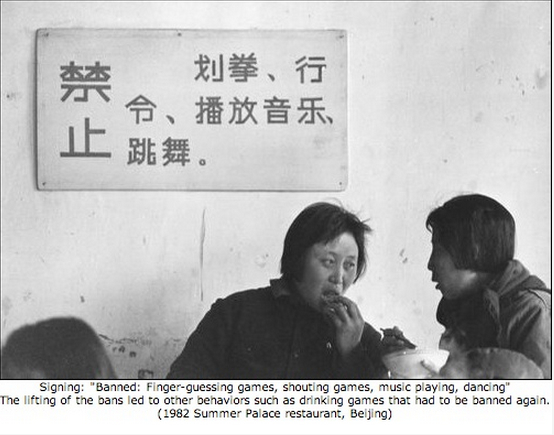

35. Scenario: Developing Historical Thinking

An artifact used by students in their history of Beijing, 1964-2014 Image: © zonaeuropa.com

Ralph Goodyear is a professor of history in a public research university in the central United States. He has a class of 72 undergraduate students taking HIST 305, ‘Historiography’. For the first three weeks of the course, Goodyear had recorded a series of short 15-minute video lectures that covered the following topics/content:

  • The various sources used by historians (e.g. earlier writings, empirical records including registries of birth, marriage, and death, eye witness accounts, artifacts such as paintings, photographs, and physical evidence such as ruins).
  • The themes around which historical analysis tend to be written.
  • Some of the techniques used by historians, such as narrative, analysis, and interpretation.
  • Three different positions or theories about history (objectivist, marxist, post modernist).

Students downloaded the videos according to a schedule suggested by Goodyear. Students attended two one hour classes a week, where specific topics covered in the videos were discussed. Students also had an online discussion forum in the course space on the university’s learning management system, where Goodyear had posted similar topics for discussion. Students were expected to make at least one substantive contribution to each online topic for which they received a mark that went towards their final grade. Students also had to read a major textbook on historiography over this three week period.

In the fourth week, he divided the class into twelve groups of six and asked each group to research the history of any city outside the United States over the last 50 years or so. They could use whatever sources they could find, including online sources such as newspaper reports, images, research publications, and so on, as well as the university’s own library collection. In writing their report, they had to do the following:

  • Pick a particular theme that covered the 50 years and write a narrative based around the theme.
  • Identify the sources they finally used in their report, and discuss why they selected some sources and dismissed others.
  • Compare their approach to the three positions covered in the lectures.
  • Post their report in the form of an online e-portfolio in the course space on the university’s learning management system.

They had five weeks to do this.

The last three weeks of the course were devoted to presentations by each of the groups, with comments, discussion, and questions, both in class and online (the in class presentations were recorded and made available online). At the end of the course, students assigned grades to each of the other groups’ work. Goodyear took these student gradings into consideration but reserved the right to adjust the grades, with an explanation of why he did the adjustment. Goodyear also gave each student an individual grade, based on both their group’s grade and their personal contribution to the online and class discussions.

Goodyear commented that he was surprised and delighted at the quality of the students’ work. He said: ‘What I liked was that the students weren’t learning about history; they were doing it.’


36. Online Learning and Teaching Methods

Online learning is increasingly influencing both classroom/campus-based teaching but more importantly, it is leading to new models or designs for teaching and learning.

When commercial movies were first produced, they were basically a transfer of previous music hall and vaudeville acts to the movie screen. Then along came D.W. Griffith’s ‘Birth of a Nation’, which transformed the design of movies, by introducing techniques that were unique to the cinema at the time, such as panoramic long shots, panning shots, realistic battle scenes, and what are now known as special effects.

A similar development has taken place with online learning. Initially, there were two separate influences: designs from classroom teaching; and designs inherited from print-based or multimedia distance education. Over time, though, new designs that fully exploit the unique characteristics of online learning are beginning to emerge.

What we do when we move teaching online is to change the learning environment. Thus, I am beginning to move from talking about teaching methods (which can be the same both in class and online) to design models, where the teaching method is deliberately adapted to the learning environment.


37. Old Wine in New Bottles: Classroom-Type Online Learning

Live video streaming of lecture  Image: Planet eStream, 2019

We start with classroom teaching methods that have been moved into a technological format with little change to the overall design principles. I will argue that these are essentially old designs in new bottles.


38. Live, Streamed Video

This is basically a classroom lecture delivered at the time of delivery to remote students (although there may also be live students in the lecture theatre as well). The remote students may be watching on their own at home, work, or in transit, or (more often) in small groups at another campus or local learning centre. There is no change in the design, although the instructor may need to make sure that the remote students are not ignored if there are questions or discussion. For an example, see here.

This is often the first step instructors take into online learning because they do not have to do anything new other than learn how to set up and switch on the equipment. As the technology became cheaper and easier to use, the use of live-streamed lectures doubled between 2016 and 2017 in Canada (Bates et al., 2018).

Some instructors require all students to be present during the live lecture in order to ensure discussion, but this can be counter-productive if the aim of going online is to increase flexibility for students. This can be countered by using an online asynchronous discussion forum in a learning management system. In most cases, though, lecturers prefer also to record the live transmission so all students can access the lecture at any time (see the next section below). 


39. Classes Using Lecture Capture

This technology, which automatically records a classroom lecture, was originally designed to enhance the classroom model by making lectures available for repeat viewings online at any time for students regularly attending classes – in other words, a form of homework or revision.

: An MIT classroom lecture recorded and made available through MIT’s OpenCourseWare.

https://ocw.mit.edu/courses/mechanical-engineering/2-003j-dynamics-and-control-i-fall-2007/video-lectures/lecture-3/

Flipped classrooms, which pre-record a lecture for students to watch on their own, followed by discussion in class, are an attempt to exploit more fully this potential. The main advantage of lecture capture is increased access, especially if students have long commutes or harsh weather to navigate. In some cases, it can reduce student drop-out dramatically. For an example of this see here.

One of the biggest impacts of lecture capture has been for ‘instructionist’ massive open online courses (xMOOCs), such as those offered by Coursera, Udacity and edX. However, even this type of MOOC is really a basic classroom design model. The main difference with a MOOC is that in a MOOC the classroom is open to anyone – but then in principle so are many university lectures – but MOOCs are available to unlimited numbers at a distance. Thus, if an institution decided to put all its recorded lectures up on an openly accessible server or on YouTube, they would become MOOCs. Nevertheless, whether lecture captures are available only to students registered in a course or as a MOOC, the design of the teaching has not changed markedly, although increasingly lectures are recorded in smaller chunks, partly as a result of research on MOOCs.


40. Courses Using Learning Management Systems

Learning management systems (LMSs) are software that enables instructors and students to log in and work within a password protected online learning environment. Most learning management systems, such as Blackboard, Desire2Learn, and Moodle, are in fact used to replicate a classroom design model. They have weekly units or modules, the instructor selects and presents the material to all students in the class at the same time, a large class enrolment can be organized into smaller sections with their own instructors, there are opportunities for (online) discussion, students work through the materials at roughly the same pace and assessment are by end-of-course tests or essays.

A screenshot of the University of British Columbia’s LMS, Blackboard Connect

The main design differences are that the content is primarily text-based rather than oral (although increasingly video and audio are now integrated into LMSs), the online discussion is mainly asynchronous rather than synchronous, and the course content is available at any time from anywhere with an Internet connection. These are important differences from a physical classroom, and skilled teachers and instructors can modify or adapt LMSs to meet different teaching or learning requirements (as they can in physical classrooms), but the basic organizing framework of the LMS remains the same as for a physical classroom.

Nevertheless, the LMS is still an advance over online designs that merely put lectures on the Internet as pre-recorded videos, or load up pdf copies of Powerpoint lecture notes, as is still the case unfortunately in many online programs. There is also enough flexibility in the design of learning management systems for them to be used in ways that break away from the traditional classroom model, which is important, as good online design should take account of the special requirements of online learners, so the design needs to be different from that of a classroom model.


41. The Limitations of the Classroom Design Model for Online Learning

Old wine can still be good wine, whether the bottle is new or not. What matters is whether classroom design meets the changing needs of a digital age. However, just adding technology to the mix, or delivering the same design online, does not automatically result in meeting changing needs.

It is important then to look at the design that makes the most of the educational affordances of new technologies, because unless the design changes significantly to take full advantage of the potential of the technology, the outcome is likely to be inferior to that of the physical classroom model which it is attempting to imitate. Thus even if the new technology, such as lecture capture and computer-based multiple-choice questions organized in a MOOC, result in helping more students memorize better or learn more content, for example, this may not be sufficient to meet the higher-level skills needed in a digital age.

The second danger of just adding new technology to the classroom design is that we may just be increasing cost, both in terms of technology and the time of instructors, without changing outcomes.

The most important reason though is that students studying online are in a different learning environment or context than students learning in a classroom, and the design needs to take account of this. This will be discussed more fully in the rest of the book.

Education is no exception to the phenomenon of new technologies being used at first merely to reproduce earlier design models before they find their unique potential. However, changes to the basic design model are needed if the demands of a digital age and the full potential of new technology are to be exploited in education.


42. The ADDIE Model

The ADDIE model.

There have been many books written about the ADDIE model (see for instance, Morrison, 2010; Dick and Carey, 2004). I give here just a very brief introduction.


43. What is ADDIE?

ADDIE stands for:

Analyze

Identify all the variables that need to be considered when designing the course, such as learner characteristics, learners’ prior knowledge, resources available, etc.  This stage is similar to the describing the learning environment outlined in Appendix 1 of this book.

Design

This stage focuses on identifying the learning objectives for the course and how materials will be created and designed (for instance, it may include describing what content areas are to be covered and a storyboard outlining what will be covered in the text, audio and video and in what order), and deciding on the selection and use of technology, such as an LMS, video or social media

Develop

The creation of content, including whether to develop in-house or outsource, copyright clearance for third party materials, loading of content into a web site or LMS, and so on.

Implement

This is the actual delivery of the course, including any prior training or briefing of learner support staff, and student assessment.

Evaluate

Feedback and data is collected in order to identify areas that require improvement and this feeds into the design, development and implementation of the next iteration of the course.


44. Where is ADDIE Used?

This is a design model used by many professional instructional designers for technology-based teaching. ADDIE has been almost a standard for professionally developed, high-quality distance education programs, whether print-based or online. It is also heavily used in corporate e-learning and training. There are many variations on this model (my favorite is ‘PADDIE’, where planning and/or preparation are added at the start). The model is mainly applied on an iterative basis, with evaluation leading to re-analysis and further design and development modifications. One reason for the widespread use of the ADDIE model is that it is extremely valuable for large and complex teaching designs. ADDIE’s roots go back to the Second World War and derive from system design, which was developed to manage the hugely complex Normandy landings.

Many open universities, such as the U.K. Open University and the OU of the Netherlands, Athabasca University and Thompson Rivers Open University in Canada, still  make heavy use of ADDIE to manage the design of complex multi-media distance education courses. When the U.K. OU opened in 1971 with an initial intake of 20,000, it used radio, television, specially designed printed modules, textbooks, reproduced research articles in the form of selected readings that were mailed to students, and regional study groups, with teams of often 20 academics, media producers and technology support staff developing courses, and with delivery and learner support provided by an army of regional tutors and senior counselors. Creating and delivering its first courses within two years of receiving its charter would have been impossible without a systematic instructional design model, and in 2014, with over 200,000 students, the OU was still using the ADDIE approach for many of its courses.

Although ADDIE and instructional design, in general, originated in the USA, the U.K. Open University’s success in developing high-quality learning materials influenced many more institutions that were offering distance education on a much smaller scale to adopt the ADDIE model, if in a more modest way, typically with a single instructor working with an instructional designer. As distance education courses became increasingly developed as online courses, the ADDIE model continued, and is now being used by instructional designers in many institutions for the re-design of large lecture classes, hybrid learning, and for fully online courses.


45. What Are The Benefits of ADDIE?

One reason it has been so successful is that it is heavily associated with good quality design, with clear learning objectives, carefully structured content, controlled workloads for faculty and students, integrated media, relevant student activities, and assessment strongly tied to desired learning outcomes. Although these good design principles can be applied with or without the ADDIE model, ADDIE is a model that allows these design principles to be identified and implemented on a systematic and thorough basis. It is also a very useful management tool, allowing for the design and development of large numbers of courses to a standard high quality.

46. What Are The Limitations of ADDIE?

The ADDIE approach can be used with any size of teaching project, but works best with large and complex projects. Applied to courses with small student numbers and a deliberately simple or traditional classroom design, it becomes expensive and possibly redundant, although there is nothing to stop an individual teacher following this strategy when designing and delivering a course.

A second criticism is that the ADDIE model is what might be called ‘front-end loaded’ in that it focuses heavily on content design and development, but does not pay as much attention to the interaction between instructors and students during course delivery. Thus it has been criticized by constructivists for not paying enough attention to learner-instructor interaction, and for privileging more behaviourist approaches to teaching.

Another criticism is that while the five stages are reasonably well described in most descriptions of the model, the model does not provide guidance on how to make decisions within that framework. For instance, it does not provide guidelines or procedures for deciding how to choose between different media, or what assessment strategies to use. Instructors have to go beyond the ADDIE framework to make these decisions.

The over-enthusiastic application of the ADDIE model can result in overly complex design stages, with many different categories of workers (faculty, instructional designers, editors, web designers) and consequently a strong division of labour, resulting in courses taking up to two years from initial approval to actual delivery. The more complex the design and management infrastructure, the more opportunities there are for cost over-runs and very expensive programming. It is a very good example of the industrial approach to course design.

My main criticism though is that the model is too inflexible for the digital age. How does a teacher respond to rapidly developing new content, new technologies, or apps being launched on a daily basis, to a constantly changing student base? Although the ADDIE model has served us well in the past and provides a good foundation for designing teaching and learning, it can be too pre-determined, linear, and inflexible to handle more volatile learning contexts.

47. Online Collaborative Learning


48. What is Online Collaborative Learning?

The concurrence of both constructivist approaches to learning and the development of the Internet has led to the development of a particular form of constructivist teaching, originally called computer-mediated communication (CMC), or networked learning, but which has been developed into what Harasim (2017) now calls online collaborative learning theory (OCL). She describes OCL as follows (p. 90):

OCL theory provides a model of learning in which students are encouraged and supported to work together to create knowledge: to invent, to explore ways to innovate, and, by so doing, to seek the conceptual knowledge needed to solve problems rather than recite what they think is the right answer. While OCL theory does encourage the learner to be active and engaged, this is not considered to be sufficient for learning or knowledge construction……In the OCL theory, the teacher plays a key role not as a fellow-learner, but as the link to the knowledge community, or state of the art in that discipline. Learning is defined as conceptual change and is key to building knowledge. Learning activity needs to be informed and guided by the norms of the discipline and a discourse process that emphasizes conceptual learning and builds knowledge.

OCL builds on and integrates theories of cognitive development that focus on conversational learning (Pask, 1975), conditions for deep learning (Marton and Saljø, 1997; Entwistle, 2000), development of academic knowledge (Laurillard, 2001), and knowledge construction (Scardamalia and Bereiter, 2006).

From the very early days of online learning, some instructors have focused heavily on the communication affordances of the Internet (see, for instance, Hiltz and Turoff, 1978). They have based their teaching on the concept of knowledge construction, the gradual building of knowledge mainly through asynchronous online discussion among students and between students and an instructor.

Online discussion forums go back to the 1970s, but really took off as a result of a combination of the invention of the WorldWide Web in the 1990s, high-speed Internet access, and the development of learning management systems, most of which now include an area for online discussions. These online discussion forums have some differences though with classroom seminars:

  • First, they are text-based, not oral.
  • Second, they are asynchronous: participants can log in at any time, and from anywhere with an Internet connection.
  • Third, many discussion forums allow for ‘threaded’ connections, enabling a response to be attached to the particular comment which prompted the response, rather than just displayed in chronological order. This allows for dynamic sub-topics to be developed, with sometimes more than ten responses within a single thread of discussion. This enables participants to follow multiple discussion topics over a period of time.


49. Core Design Principles of OCL

Harasim emphasizes the importance of three key phases of knowledge construction through discourse:

  • Idea Generating: This is literally brainstorming, to collect the divergent thinking within a group.
  • Idea Organizing: This is where learners compare, analyze and categorize the different ideas previously generated, again through discussion and argument.
  • Intellectual Convergence: The aim here is to reach a level of intellectual synthesis, understanding and consensus (including agreeing to disagree), usually through the joint construction of some artifact or piece of work, such as an essay or assignment.

This results in what Harasim calls a Final Position, although in reality, the position is never final because for a learner, once started, the process of generating, organizing and converging on ideas continues at an ever deeper or more advanced level. The role of the teacher or instructor in this process is seen as critical, not only in facilitating the process and providing appropriate resources and learner activities that encourage this kind of learning, but also, as a representative of a knowledge community or subject domain, in ensuring that the core concepts, practices, standards, and principles of the subject domain are fully integrated into the learning cycle.

Harasim provides the following diagram to capture this process:

Harasim’s pedagogy of group discussion (from Harasim, 2017, p. 95, with permission)

Another important factor is that in the OCL model, discussion forums are not addition or supplement to core teaching materials, such as textbooks, recorded lectures, or text in an LMS, but are the core component of the teaching. Textbooks, readings and other resources are chosen to support the discussion, not the other way round.

This is a key design principle, and explains why often instructors or tutors complain, in more ‘traditional’ online courses, that students don’t participate in discussions. Often this is because where online discussions are secondary to more didactic teaching, or are not deliberately designed and managed to lead to knowledge construction, students see the discussions as optional or extra work because they have no direct impact on grades or assessments.

It is also a reason why awarding grades for participation in discussion forums misses the point. It is not the extrinsic activity that counts, but the intrinsic value of the discussion, that matters (see, for instance, Brindley, Walti and Blashke, 2009). Thus although instructors using an OCL approach may use learning management systems for convenience, they are used differently from courses where traditional didactic teaching is moved online.

50. Community of Inquiry


The Community of Inquiry Model (CoI) is somewhat similar to the OCL model. As defined by Garrison, Anderson, and Archer (2000):

An educational community of inquiry is a group of individuals who collaboratively engage in purposeful critical discourse and reflection to construct personal meaning and confirm mutual understanding.

Garrison, Anderson and Archer argue that there are three essential elements of a community of inquiry:

  • Social Presence: Is “the ability of participants to identify with the community (e.g., course of study), communicate purposefully in a trusting environment, and develop inter-personal relationships by way of projecting their individual personalities.”
  • Teaching Presence:  Is “the design, facilitation, and direction of cognitive and social processes for the purpose of realizing personally meaningful and educationally worthwhile learning outcomes” 
  • Cognitive Presence: Is “the extent to which learners are able to construct and confirm meaning through sustained reflection and discourse“.

Community of Inquiry Image: © Terry Anderson/Marguerite Koole, 2013However, CoI is more of a theory than a model, since it does not indicate what activities or conditions are needed to create these three ‘presences’. The two models (OCL and CoI) are also more complementary rather than competing.
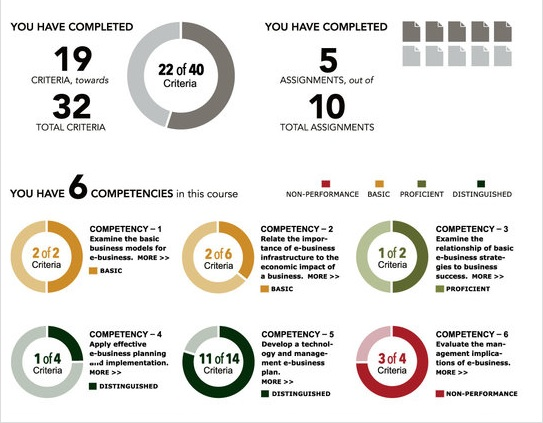



51. Developing Meaningful Online Discussion

Since the publication of the original CoI paper in 2000, there have been a number of studies that have identified the importance of these ‘presences’ within especially online learning (click here for a wide selection). Although there has been a wide range of researchers and educators engaged in the area of online collaborative learning and communities of inquiry, there is a high degree of convergence and agreement about successful strategies and design principles. For academic and conceptual development, discussions need to be well organized by the teacher, and the teacher needs to provide the necessary support to enable the development of ideas and the construction of new knowledge for the students.

Partly as a result of this research, and partly as the result of experienced online instructors who have not necessarily been influenced by either the OCL or the Community of Inquiry literature, several other design principles have been associated with successful (online) discussion, such as:

  • Appropriate technology (for example, software that allows for threaded discussions)
  • Clear guidelines on student online behaviour, such as written codes of conduct for participating in discussions, and ensuring that they are enforced
  • Student orientation and preparation, including technology orientation and explaining the purpose of discussion
  • Clear goals for the discussions that are understood by the students, such as: ‘to explore gender and class issues in selected novels’ or ‘to compare and evaluate alternative methods of coding’
  • Choice of appropriate topics, that complement and expand issues in the study materials, and are relevant to answering assessment questions
  • Setting an appropriate ‘tone’ or requirements for discussion (for example, respectful disagreement, evidence-based arguments)
  • Defining clearly learner roles and expectations, such as ‘you should log in at least once a week to each discussion topic and make at least one substantive contribution to each topic each week’
  • Monitoring the participation of individual learners, and responding accordingly, by providing the appropriate scaffolding or support, such as comments that help students develop their thinking around the topics, referring them back to study materials if necessary, or explaining issues when students seem to be confused or misinformed;
  • Regular, ongoing instructor ‘presence’, such as monitoring the discussions to prevent them from getting off-topic or too personal, and providing encouragement for those that are making real contributions to the discussion, heading off those that are trying to hog or dominate the discussions, and tracking those not participating, and helping them to participate;
  • Ensuring strong articulation between discussion topics and assessment

These issues are discussed in more depth by Salmon (2000); Bates and Poole (2003); and Paloff and Pratt (2005; 2007).


52. Cultural and Epistemological Issues

Students come to the educational experience with different expectations and backgrounds. As a result there are often major cultural differences in students with regard to participating in discussion-based collaborative learning that in the end reflect deep differences with regard to the traditions of learning and teaching. Thus teachers need to be aware that there are likely to be students in any class who may be struggling with the language, cultural or epistemological issues, but in online classes, where students can come from anywhere, this is a particularly important issue.

In many countries, there is a strong tradition of the authoritarian role of the teacher and the transmission of information from the teacher to the student. In some cultures, it would be considered disrespectful to challenge or criticize the views of teachers or even other students. In an authoritarian, teacher-based culture, the views of other students may be considered irrelevant or unimportant. Other cultures have a strong oral tradition or one based on story-telling, rather than on direct instruction.

Online environments then can present real challenges to students when a constructivist approach to the design of online learning activities is adopted. This may mean taking specific steps to help students who are unfamiliar with a constructivist approach to learning, such as asking a student to send drafts to the instructor by e-mail for approval before posting a ‘class’ contribution. For a fuller discussion of cross-cultural issues in online learning, see Jung and Gunawardena (2014) and the journal Distance Education, Vol. 22, No. 1 (2001), the whole edition of which is devoted to papers on this topic.


53. Strengths and Weaknesses of Online Collaborative Learning

This approach to the use of technology for teaching is very different from the more objectivist approaches found in computer-assisted learning, teaching machines, and artificial intelligence applications to education, which primarily aim to use computing to replace at least some of the activities traditionally done by human teachers. With online collaborative learning, the aim is not to replace the teacher, but to use the technology primarily to increase and improve communication between teacher and learners, with a particular approach to the development of learning based on knowledge construction assisted and developed through social discourse. This social discourse furthermore is not random but managed in such a way as to ‘scaffold’ learning:

  • By assisting with the construction of knowledge in ways that are guided by the instructor.
  • That reflects the norms or values of the discipline.
  • That also respect or take into consideration the prior knowledge within the discipline.

Thus there are two main strengths of this model:

  • When applied appropriately, online collaborative learning can lead to deep, academic learning, or transformative learning, as well as, if not better than, discussion in campus-based classrooms. The asynchronous and recorded ‘affordances’ of online learning more than compensate for the lack of physical cues and other aspects of face-to-face discussion.
  • Online collaborative learning, as a result, can also directly support the development of a range of high-level intellectual skills, such as critical thinking, analytical thinking, synthesis, and evaluation, which are key requirements for learners in a digital age.

There are though some limitations:

  • It does not scale easily, requiring highly knowledgeable and skilled instructors, and a limited number of learners per instructor.
  • It is more likely to accommodate to the epistemological positions of faculty and instructors in humanities, social sciences, education and some areas of business studies and health and conversely it is likely to be less accommodating to the epistemological positions of faculty in science, computer science and engineering. However, if combined with a problem-based or inquiry-based approach, it might have acceptance even in some of the STEM subject domains.


54. Competency-Based Learning


55. What is Competency-Based Learning?

Competency-based learning begins by identifying specific competencies or skills, and enables learners to develop mastery of each competency or skill at their own pace, usually working with a mentor. Learners can develop just the competencies or skills they feel they need (for which increasingly they may receive a ‘badge’ or some form of validated recognition), or can combine a whole set of competencies into a full qualification, such as a certificate, diploma, or increasingly a full degree.

Learners work individually, usually online, rather than in cohorts. If learners can demonstrate that they already have mastery of a particular competency or skill, through a test or some form of prior learning assessment, they may be allowed to move to the next level of competency without having to repeat a prescribed course of study for the prior competency. Competency-based learning attempts to break away from the regularly scheduled classroom model, where students study the same subject matter at the same speed in a cohort of fellow students.

The value of competency-based learning for developing practical or vocational skills or competencies is more obvious, but increasingly competency-based learning is being used for education requiring more abstract or academic skills development, sometimes combined with other cohort-based courses or progr


56. Who Uses Competency-Based Learning?

The Western Governors University in the USA, with nearly 40,000 students, has pioneered competency-based learning, but, with the more recent support of the Federal Department of Education, competency-based learning is expanding rapidly in the USA. Other institutions making extensive use of competency-based learning are Southern New Hampshire University through its College for America, designed specifically for working adults and their employers, Northern Arizona University, and Capella University.

Competency-based learning is particularly appropriate for adult learners with life experience who may have developed competencies or skills without formal education or training, for those who started school or college and dropped out and wish to return to formal study, but want their learning ‘after school’ to be recognized, or for those learners wanting to develop specific skills but not wanting a full program of studies. Competency-based learning can be delivered through a campus program, but it is increasingly delivered fully online because many students taking such programs are already working or seeking work, and because technology enables each student with a distinct pathway through content based on their prior knowledge.


57. Designing Competency-Based Learning

There are various approaches, but the Western Governors’ model illustrates many of the key steps.

Defining Competencies

A feature of most competency-based programs is a partnership between employers and educators in identifying the competencies required, at least at a high level. Some of the skills outlined such as problem-solving or critical thinking, maybe considered high-level, but competency-based learning tries to break down abstract or vague goals into specific, measurable competencies.

For instance, at Western Governors University (WGU), for each degree, a high-level set of competencies is defined by the University Council, and then a working team of contracted subject matter experts take the ten or so high-level competencies for a particular qualification and breaks them down into about 30 more specific competencies, around which are built online courses to develop mastery of each competency. Competencies are based upon what graduates are supposed to know in the workplace and as professionals in a chosen career. Assessments are designed specifically to assess the mastery of each competency; thus students receive either a pass/no pass following assessment. A degree is awarded when all 30 specified competencies are successfully achieved.

Defining competencies that meet the needs of students and employers in ways that are progressive (in that one competency builds on earlier competencies and leads to more advanced competencies) and coherent (in that the sum of all the competencies produces a graduate with all the knowledge and skills required within a business or profession) is perhaps the most important and most difficult part of competency-based learning.

Course and Program Design

At WGU, courses are created by in-house subject matter experts selecting existing online curriculum from third parties and/or resources such as e-textbooks through contracts with publishers. Increasingly open educational resources are used. WGU does not use a learning management system but a specially designed portal for each course. E-textbooks are offered to students without extra cost to the student, through contracts between WGU and the publishers. Courses are pre-determined for the student with no electives. Students are admitted on a monthly basis and work their way through each competency at their own pace.

Students who already possess competencies may accelerate through their program in two ways: transferring in credits from a previous associate degree in appropriate areas (e.g. general education, writing); or by taking exams when they feel they are ready (sometimes known as direct assessment).

Learner Support

Again this varies from institution to institution. WGU currently employs approximately 750 faculty who act as mentors. There are two kinds of mentors: ‘student’ mentors and ‘course’ mentors. Student mentors, who have qualifications within the subject domain, usually at a masters level, are in at least bi-weekly telephone contact with their students, depending on the needs of the student in working through their courses, and are the main contact for students. A student mentor is responsible for roughly 85 students. Students start with a mentor from their first day and stay with their mentor until graduation. Student mentors assist students in determining and maintaining an appropriate pace of study and step in with help when students are struggling.

Course mentors are more highly qualified, usually with a doctorate, and provide extra support for students when needed. Course mentors will be available to between 200-400 students at a time, depending on the subject requirement.

Students may contact either student or course mentors at any time (unlimited access) and mentors are expected to deal with student calls within one business day. Mentors are full-time but work flexible hours, usually from home. Mentors are reasonably well paid and receive extensive training in mentoring.

Assessment

WGU uses written papers, portfolios, projects, observed student performance, and computer-marked assignments as appropriate, with detailed rubrics. Assessments are submitted online and if they require human evaluation, qualified graders (subject matter experts trained by WGU in assessment) are randomly assigned to mark work on a pass/fail basis. If students fail, the graders provide feedback on the areas where competency was not demonstrated. Students may resubmit if necessary.

Remote proctoring of exams at Western Governors’ University

Students will take both formative (pre-assessment) and summative (proctored) exams. WGU is increasingly using online proctoring, enabling students to take an exam at home under video supervision, using facial recognition technology to ensure that the registered student is taking the exam. In areas such as teaching and health, student performance or practice is assessed in situ by professionals (teachers, nurses).

 Example transcript from Northern Arizona University

Direct assessment, meaning students taking an exam when they feel ready, is, of course, de-coupled from the standard credit hour, since different students may take different times to reach proficiency. In the USA, where financial aid is generally linked to the number of credit hours in a course or program, this can cause problems with regulatory agencies. Although regulators are grappling with this issue, the uncertainty around financial aid is a major reason for the relatively low use of direct assessment in competency-based learning, despite it being one of its main advantages (see Fain, 2019, for more on this issue).


58. Strengths and Weaknesses

Proponents have identified a number of strengths in the competency-based learning approach:

  • It meets the immediate needs of businesses and professions; students are either already working, and receive advancement within the company, or if unemployed, are more likely to be employed once qualified.
  • It enables learners with work or family commitments to study at their own pace.
  • For some students, it speeds up time to completion of qualification by enabling prior learning to be recognized.
  • Students get individual support and help from their mentors.
  • Tuition fees are affordable (US$6,000 per annum at WGU) and programs can be self-funding from tuition fees alone, since WGU uses already existing study materials and increasingly open educational resources.
  • Competency-based education is gradually being recognized as eligible for Federal loans and student aid in the USA.
  • Capella University has found (Klein and DeSchryver, 2019) that students taking courses with direct assessment:
    • Have a higher two-year persistence rate than their like peers in Capella’s traditional programs.
    • Progress more quickly through bachelor’s and master’s degree programs, compared to similar students in Capella’s equivalent credit-hour programs.
    • Are charged less in tuition and borrow less than like students in Capella’s equivalent credit-hour programs.

Consequently, institutions such as WGU, the University of Southern New Hampshire, and Northern Arizona University, using a competency-based approach, at least as part of their operations, has seen annual enrolment growth in the range of 30-40 percentage per annum.

Its main weakness is that it works well with some learning environments and less well with others. In particular:

  • It focuses on an immediate employer needs and is less focused on preparing learners with the flexibility needed for a more uncertain future.
  • It does not suit subject areas where it is difficult to prescribe specific competencies or where new skills and new knowledge need to be rapidly accommodated.
  • It takes an objectivist approach to learning; constructivists would argue that skills are not either present or absent (pass or fail), but have a wide range of performance and continue to develop over time.
  • It ignores the importance of social learning.
  • It will not fit the preferred learning styles of many students.

2015 report by EAB, a private educational consultancy identified three ‘myths’ about about competency-based education:

  • High demand: in fact, EAB reported a lack of demand from students or employers.
  • Faster and cheaper for students: in fact, it is difficult for students, especially working adults, to complete competencies fast enough for there to be savings over conventional programs.
  • Cheaper for institutions: in fact, because of the need for new systems such as on-demand registration, and different reporting for government financial aid, institutional costs are often higher than anticipated.


59. Communities of Practice


60. The Theories Behind Communities of Practice

The design of teaching often integrates different theories of learning. Communities of practice are one of the ways in which experiential learning, social constructivism, and connectivism can be combined, illustrating the limitations of trying to rigidly classify learning theories. Practice tends to be more complex.

61. What are Communities of Practice?

Definition

Communities of practice are groups of people who share a concern or a passion for something they do and learn how to do it better as they interact regularly.

Wenger, 2014

What are Communities of Practice?

The basic premise behind communities of practice is simple: we all learn in everyday life from the communities in which we find ourselves. Communities of practice are everywhere. Nearly everyone belongs to some community of practice, whether it is through our working colleagues or associates, our profession or trade, or our leisure interests, such as a book club. Wenger (2000) argues that a community of practice is different from a community of interest or a geographical community in that it involves a shared practice: ways of doing things that are shared to some significant extent among members.

Characteristics

Wenger argues that there are three crucial characteristics of a community of practice:

  • Domain: A common interest that connects and holds together the community.
  • Community: A community is bound by the shared activities they pursue (for example, meetings, discussions) around their common domain.
  • Practice: Members of a community of practice are practitioners; what they do informs their participation in the community; and what they learn from the community affects what they do.

Innovation and Change

Wenger (2000) has argued that although individuals learn through participation in a community of practice, more important is the generation of newer or deeper levels of knowledge through the sum of the group activity. If the community of practice is centered around business processes, for instance, this can be of considerable benefit to an organization. Smith (2003) notes that:

…Communities of practice affect performance..[This] is important in part because of their potential to overcome the inherent problems of a slow-moving traditional hierarchy in a fast-moving virtual economy. Communities also appear to be an effective way for organizations to handle unstructured problems and to share knowledge outside of the traditional structural boundaries. In addition, the community concept is acknowledged to be a means of developing and maintaining long-term organizational memory.

Brown and Duguid (2000) describe a community of practice developed around the Xerox customer service representatives who repaired the machines in the field. The Xerox reps began exchanging tips and tricks over informal meetings at breakfast or lunch and eventually, Xerox saw the value of these interactions and created the Eureka project to allow these interactions to be shared across the global network of representatives. The Eureka database has been estimated to have saved the corporation $100 million. Companies such as Google and Apple are encouraging communities of practice through the sharing of knowledge across their many specialist staff.

Technology

Technology provides a wide range of tools that can support communities of practice, as indicated by Wenger (2014) in the diagram below:

Tools that support communities of practice

62. Designing Effective Communities of Practice

Most communities of practice have no formal design and tend to be self-organizing systems. They have a natural life cycle and come to an end when they no longer serve the needs of the community. However, there is now a body of theory and research that has identified actions that can help sustain and improve the effectiveness of communities of practice.

Wenger, McDermott, and Snyder (2002) have identified seven key design principles for creating effective and self-sustaining communities of practice, related specifically to the management of the community, although the ultimate success of a community of practice will be determined by the activities of the members of the community themselves. Designers of a community of practice need to:

Design for Evolution

Ensure that the community can evolve and shift in focus to meet the interests of the participants without moving too far from the common domain of interest.

Open a Dialogue between Inside and Outside Perspectives

Encourage the introduction and discussion of new perspectives that come or are brought in from outside the community of practice.

Encourage and Accept Different Levels of Participation

Different levels of participation include:

  • The ‘core’ (most active members)
  • Those who participate regularly but do not take a leading role in active contributions
  • Hose (likely the majority) who are on the periphery of the community but may become more active participants if the activities or discussions start to engage them more fully

Develop Both Public and Private Community Spaces

Communities of practice are strengthened if they encourage individual or group activities that are more personal or private as well as the more public general discussions; for instance, individuals may decide to blog about their activities or a small group in an online community that live or work close together may also decide to meet informally on a face-to-face basis.

Focus on Value

Attempts should be made explicitly to identify, through feedback and discussion, the contributions that the community most values.

Combine Familiarity and Excitement

Focus both on shared, common concerns and perspectives, but also on the introduction of radical or challenging perspectives for discussion or action.

Create a Rhythm for the Community

There needs to be a regular schedule of activities or focal points that bring participants together on a regular basis, within the constraints of participants’ time and interests.


63. Critical Factors for Success

Subsequent research has identified a number of critical factors that influence the effectiveness of participants in communities of practice, These include being:

  • Aware of social presence: Individuals need to feel comfortable in engaging socially with other professionals or ‘experts’ in the domain, and those with greater knowledge must be willing to share in a collegial manner that respects the views and knowledge of other participants (social presence is defined as the awareness of others in an interaction combined with an appreciation of the interpersonal aspects of that interaction.)
  • Motivated to share information for the common good of the community.
  • Able and willing to collaborate.

EDUCAUSE has developed a step-by-step guide for designing and cultivating communities of practice in higher education (Cambridge, Kaplan, and Suter, 2005).

Lastly, research on other related sectors, such as collaborative learning or MOOCs, can inform the design and development of communities of practice. For instance, communities of practice need to balance between structure and chaos: too much structure and many participants are likely to feel constrained in what they need to discuss; too little structure and participants can quickly lose interest or become overwhelmed.

Many of the other findings of group and online behavior, such as the need to respect others, observing online etiquette, and preventing certain individuals from dominating the discussion, are all likely to apply. However, because many communities of practice are by definition self-regulating, establishing rules of conduct and even more so enforcing them is really a responsibility of the participants themselves.


64. Learning Through Communities of Practice in a Digital Age

Communities of practice are a powerful manifestation of informal learning. They generally evolve naturally to address commonly shared interests and problems. By their nature, they tend to exist outside formal educational organizations. Participants are not usually looking for formal qualifications, but to address issues in their life and to be better at what they do. Furthermore, communities of practice are not dependent on any particular medium; participants may meet face-to-face socially or at work, or they can participate in online or virtual communities of practice.

It should be noted that communities of practice can be very effective in a digital world, where the working context is volatile, complex, uncertain, and ambiguous. A large part of the lifelong learning, the market will become occupied by communities of practice and self-learning, through collaborative learning, sharing of knowledge and experience, and crowd-sourcing new ideas and development. Such informal learning provision will be particularly valuable for non-governmental or charitable organizations, such as the Red Cross, Greenpeace or UNICEF, or local government, looking for ways to engage communities in their areas of operation.

These communities of learners will be open and free, and hence will provide a competitive alternative to the high priced lifelong learning programs being offered by research universities. This will put pressure on universities and colleges to provide more flexible arrangements for recognition of informal learning, in order to hold on to their current monopoly of post-secondary accreditation.

One of the significant developments in recent years have been the use of massive open online courses (MOOCs) for developing online communities of practice. MOOCs are discussed in more detail but it is worth discussing here the connection between MOOCs and communities of practice. The more instructionist xMOOCs are not really developed as communities of practice, because they use mainly a transmissive pedagogy, from experts to those considered less expert.

In comparison, connectivist MOOCs are an ideal way to bring together specialists scattered around the world to focus on a common interest or domain. Connectivist MOOCs are much closer to being virtual communities of practice, in that they put much more emphasis on sharing knowledge between more or less equal participants. However, current connectivist MOOCs do not always incorporate what research indicates are best practices for developing communities of practice, and those wanting to establish a virtual community of practice at the moment need some kind of MOOC provider to get them started and give them access to the necessary MOOC software.

Although communities of practice are likely to become more rather than less important in a digital age, it is probably a mistake to think of them as a replacement for traditional forms of education. There is no single, ‘right’ approach to the design of teaching. Different groups have different needs. Communities of practice is more of an alternative for certain kinds of learners, such as lifelong learners, and are likely to work best when participants already have some domain knowledge and can contribute personally and in a constructive manner – which suggests the need for at least some form of prior general education or training for those participating in effective communities of practice.

In conclusion, it is clear is that in an increasingly volatile, uncertain, complex, and ambiguous world, and given the openness of the Internet, the social media tools now available, and the need for sharing of knowledge on a global scale, virtual communities of practice will become even more common and important. Smart educators and trainers will look to see how they can harness the strength of this design model, particularly for lifelong learning. However, merely lumping together large numbers of people with a common interest is unlikely to lead to effective learning.  Attention needs to be paid to those design principles that lead to effective communities of practice.


65. Scenario: ETEC 522: Ventures in e-Learning

Image: Harper Adams University

Mike: Hey, George, come and sit down and tell Allison and Rav about that weird course you’re taking from UBC.

George: Hi, you two. Yeah, it’s a great course, very different from any other I’ve taken.

Rav: What’s it about?

George: It’s how to go about starting up a technology company.

Allison: But I thought you were doing a master's in education.

George: Yeah, I am. This course is looking at how new technologies can be used in education and how to build a business around one of these technologies.

Mike: Really, George? So what about all your socialist principles, the importance of public education, and all that? Are you giving up and going to become a fat capitalist?

George: No, it’s not like that. What the course is really making me do is think about how we could be using technology better in school or college.

Mike: And how to make a profit out of it, by the sound of it.

Rav.: Shut up, Mike – I’m curious, George since I’m doing a real business program. You’re going to learn how to set up a business in 13 weeks? Gimme a break.

George: It’s more about becoming an entrepreneur – someone who takes risks and tries something different.

Mike.: With someone else’s money.

George: Do you really want to know about this course, or are you just wanting to give me a hard time?

Allison: Yes, shut up, Mike. Have you chosen a technology yet, George?

George: Almost. We spend most of the course researching and analyzing emerging technologies that could have an application in education. We have to find a technology, research it then come up with a plan of how it could be used in education, and how a business could be built around it. But I think the real aim is to get us to think about how technology could improve or change teaching or learning.

Rav.: So what’s the technology you’ve chosen?

George: You’re jumping too far ahead, Rav. We go through two boot camps, one on analyzing the edtech marketplace, and one on entrepreneurship: what it takes to be an entrepreneur. Why are you laughing, Mike?

Mike: I just can’t see you in combat uniform, crawling through tubes under gunfire, with a book in your hand.

George: Not that kind of boot camp. This course is totally online. Our instructor points us in the direction of a few technologies to get us started, but because there’s more stuff coming out all the time, we’re encouraged to make our own choices about what to research. And we all help each other. I must have looked at more than 50 products or services so far, and we all share our analyses. I’m down to possibly three at the moment, but I’m going to have to make my mind up soon, as I have to do a YouTube elevator pitch for my grade.

Rav.: A what?

George: If you look at most of these products, there’s a short YouTube video that pitches the business. I’ve got to make the case for whatever technology I choose in just under eight minutes. That’s going to be 25% of my grade.

Allison: Wow, that’s tough.

George: Well, we all help each other. We have to do a preliminary recording, then everyone pitches in to critique it. Then we have a few days to send in our final version.

Allison: What else do you get grades for?

George: I got 25% of my marks for an assignment that analyzed a particular product called Dybuster which is used to help learners with dyslexia. I looked mainly at its educational strengths and weaknesses, and its likely commercial viability. For my second assignment, also worth 25%, we had to build an application of a particular product or service, in my case a module of teaching using a particular product. There were four of us altogether working as a team to do this. Our team designed a short instructional module that showed a chemical reaction, using an off-the-shelf online simulation tool that is free for people to use. I’ll get my last 25% from analyzing my own contribution to discussions and activities.

Rav.: What, you give yourself the grade?

George: No, I have to collect my best contributions together in a sort of portfolio, then send them in to the instructor, who then gives the grade based on the quality of the contributions.

Allison: But what I don’t understand is: what’s the curriculum? What text books do you have to read? What do you have to know?

George: Well, there are the two boot camps, but really, we the students, set the curriculum. Our instructor asks us for our first week’s work to look at a range of emerging technologies that might be relevant for education, then we select eight which form the basis of our work groups. I’ve already learned a lot, just by searching and analyzing different products over the Internet. We have to think about and justify our decisions. What kind of teaching philosophy do they imply? What criteria am I using when I support or reject a particular product? Is this a sustainable tool? (You don’t want to have to get rid of good teaching material because the company’s gone bust and doesn’t support the technology any more). What I’m really learning though is to think about technology differently. Previously I wasn’t really thinking about teaching differently. I was just trying to find a technology that made my life easier. But this course has woken me up to the real possibilities. I feel I’m in a much better position now to shake up my own school and move them into the digital age.

Allison (sighs): Well, I guess that’s the difference between an undergraduate and a graduate course. You couldn’t do this unless you already knew a lot about education, could you?

George: I’m not so sure about that, Allison. It doesn’t seem to have stopped a lot of entrepreneurs from developing tools for teaching!

Mike: George, I’m sorry. I can’t wait for you to become a rich capitalist – it’s your turn to buy the drinks.

Scenario-based on a UBC graduate course for the Master in Educational Technology.

The instructors are David Vogt and David Porter, assisted by Jeff Miller, the instructional designer for the course.